Yes, Get Over It — Constructively

16832288_10208629742763961_1882694048835745391_n
Rep. Steve Womack addressing an overflowing crowd at town hall Feb 21, 2017

Yesterday I attended a town hall meeting sponsored by Rep. Steve Womack (Republican) of our 3rd Congressional District (Northwest Arkansas). The room would comfortably hold thirty people. Over 200 showed up. With the hallways and doorways and standing room thronged, half the people ended up standing outside in the parking lot for the 1.5 hour event. In light rain and a heavy temper.

Womack could have taken charge of the situation by reconvening five blocks away in the much larger community center. He chose not to do so. He could have opened the meeting by immediately taking questions, but instead he spent at least twenty minutes talking about his agenda. His primary concern was the national debt which he elaborated citing numbers and projections intended to shock and awe.

Not surprising for Col. Womack, a 30-year national guard veteran who commanded the 2nd Battalion, 153rd Infantry, 39th Separate Infantry Brigade in the Sinai, Egypt, between 2002 and 2009. He’s a member of Cross Church, earthly kingdom of Ronnie Floyd who has served in a leadership role of the world’s largest Southern Baptist denomination and the largest Protestant body in the United States, with over 15 million members as of 2016. Womack is a poster child for the right wing.

The Arkansas 3rd district rolled to the Republican side in 1967 following continuous Democratic control since Reconstruction and has remained in Republican hands ever since. Only a couple of times have strong Democratic candidates come close (1992: 47.2% to 50.2%) to regaining the seat while generally Republicans enjoy over 70% majority on Election Day. Womack is serving his fourth term.

Despite this position of strength for Womack, the crowd wasn’t having it. In a surly mood in a room whose temperature approached one hundred degrees due to severe overcrowding, people jostled signs, interrupted, and talked over Rep. Womack in what became the norm for the entire exchange. His temper flared on occasion, telling people to shut-up and reiterating his party line position on issues ranging from the EPA to National Endowment for the Arts to Medicare. Less than a quarter of those who wanted to ask questions were actually able to do so before his ‘drop dead’ quit time of 10 a.m.

Driving home, I kept wondering what people actually expected. Did anyone think for an instant that he would agree to demands that he personally ‘do something’ about the ‘man-child Trump,’ as one speaker requested? Did anyone think that he would suddenly veer off the positions in which the political right has grown increasingly entrenched for the last fifty years?

I didn’t. I know lots of people like him. They’re my relatives and my neighbors. They’re positive they’re right. Nothing is going to change them.

But after a lifetime of advocacy on various impossible causes (women’s rights, environment, and most recently drug policy reform), I remain optimistic that in some small demilitarized zone between right and left, a productive dialogue can lead to some understanding. At the least, a grudging mutual respect.

Few in the crowd seemed to understand that philosophy. They had an ax to grind in their outrage over Donald Trump and his agenda. They wanted to shout and hurl accusations. Whatever ground might have been gained in building a tenuous link of communication died under the stomping feet of those who only wanted to protest what has come to be the current reality: Republicans control the government.

Despite a few well-considered questions that earned a thoughtful response from Rep. Womack, less than a quarter of those who kept raising hands ever had a chance to speak. Womack avoided replying to demands for increasing taxes on the so-called ‘one percent’ as he explaining how government had exceeded its mandate and was spending two-thirds of its income on ‘mandatory’ programs compared to the 1960s when mandatory only consumed one third.

Womack, along with the Republican majority, condemn food stamps and other social support programs as well as protections for waterways and the air we breathe. This isn’t a new conflict. It’s been picking up steam for five decades. Aligned on the side of the protesters are the progressives who—many of them—have worked to enact those very programs. Aligned on Womack’s side are those who see those programs as a symptom of moral decay.

Railing about the national debt is a convenient cover for such moralistic thinking. Every president since Calvin Coolidge had added to the national debt, most recently George W. Bush by 101% and Obama by 68%. The elephant in the room (literally) is the wars started by Bush after 9/11. The cost of the Iraq War tops two trillion and in Afghanistan, over four trillion with no end in sight.[1]

As we all know, financing what we want when we want it ends up with the ugly reality of paying off debt without getting anything in return. With interest. This is the staggering problem keeping Womack and other legislators awake at night, Democrats among them. But while the portion of national revenues dedicated to mandatory spending has increased, military spending now gobbles up fifty percent of discretionary spending. So while Womack et al set their sights on cutting other discretionary spending such as public broadcasting,[2] none of them mention the possibility of letting the Middle East sink or swim on its own.

Republicans seem hell bent on continuing to wage war on behalf of Israel and oil, throwing in the specter of terrorism and a nuclear Iran for good measure. The truth is, none of these ‘reasons’ hold water. The U. S. could fully withdraw from the Middle East without suffering any real threat here at home.[3] But that would outrage the special interests: military contractors, oil sheikdoms, the Israel lobby, and a hypnotized electorate who equates patriotism and war.

Unless we culturally divest from war, even a massive cut in non-military discretionary spending would do little to offset the debt, much less make a dent in the mandatory side of the scales.[4] And while Social Security and Medicare are theoretically paid for through payroll tax deductions, the increasingly longer projected life expectancy of Americans means that people far outlive the amount they’ve paid in.[5] Fewer workers paying for increasing numbers of retirees leads to the brick wall ahead.

One of the main arguments raised against Womack’s insistence on cutting programs, including ‘restructuring’ mandatory spending programs, was the repeated cry to increase taxes on the rich. He never once acknowledged the question or attempted to answer. The facts are that in the 1950s and ‘60s, the time praised by Womack when mandatory spending only constituted about a third of the national revenue, the wealthiest Americans paid a top income tax rate of 91%. Today, the top rate is 43.4%. In 2014, after deductions, the richest one-percent paid an effective federal income tax rate of 24.7%.[6]

Loopholes which allow billionaires like Trump to pay zero taxes have been skillfully placed into the tax code by cooperative legislators benefiting from generous campaign contributions and other perks. These same legislators prize their own interests above their constituents, catering to corporate profits instead of forcing lower prices on essentials like prescription drugs. This outrages Americans, causes distrust in government, and propels a demagogue like Trump into power.

Meanwhile, in the guise of addressing the debt, Republicans gleefully set about righting the perceived moral decay they’ve campaigned on since Ronald Reagan. They’re eager to cut federal spending for Planned Parenthood (further restrict abortion rights), public radio and television (stifle the progressive agenda), and especially social support programs like unemployment and food stamps (force slackers to work), but such changes promise little more than a drop in the bucket of deficits.

As in yesterday’s meeting with Womack, progressives repeatedly fail to make a strong case for their agenda or provide meaningful solutions to the nation’s fiscal distress. Angry demonstrations only delay what progressives must do to take back leadership of the political spectrum. We must show why improving conditions for the poor, the jobless, and the weakest among us is the only path to solvency, why strong environmental protection must be preserved, why women must be allowed to decide who gets born.

These arguments must be made, and in order for them to gain purchase in the near term, dialogue with elected officials like Womack is essential. Public tantrums are counterproductive. In the long term, refinement of and spirited advocacy for progressive policies will form the platform by which a progressive political party can regain control. Among us, we must find those willing to sacrifice themselves to the public arena as candidates capable of inciting voters’ imaginations with such an agenda.

Then will be the time to shout.

~~~


[1] https://www.theatlantic.com/international/archive/2016/09/cost-wars-iraq-afghanistan/499007/

[2] https://www.nationalpriorities.org/campaigns/military-spending-united-states/

[3]  http://www.huffingtonpost.com/jeff-faux/why-are-we-in-the-middle_b_7301370.html

[4] https://www.nationalpriorities.org/budget-basics/federal-budget-101/spending/

[5] https://www.thebalance.com/current-federal-mandatory-spending-3305772

[6] http://americansfortaxfairness.org/tax-fairness-briefing-booklet/fact-sheet-taxing-wealthy-americans/


Treason In The Name of God Is Still Treason

chknvegw0aisix5

The United States now faces a Republican government whose members openly state their wish to make the country a Christian nation. Vice President Pence, among others, has proudly proclaimed that his God comes before country. Legislators compete to ‘out-Christian’ each other in conservative Congressional districts.

What are these people thinking?

The Founding Fathers set down rules about this new nation. The constitution specifically restricts government establishment of religion. Do Pence et al not know this? Or are they too wrapped up in zealotry to realize what’s at stake?

A recent Pew Research Center poll delivers the news that while only 71% of Americans identify as “Christian,” over 90% of legislators do so.

Why have the ‘nones’ grown in the public, but not among Congress?” asked Greg Smith, associate director for research at Pew, referring to people who check “none” on surveys asking their religion.

One possible explanation is people tell us they would rather vote for an elected representative who is religious than for one who is not religious.[1]

Evidently voters assume that a religious legislator is more trustworthy, this despite the fact that a long list of religious elected officials have been indicted and/or convicted of  crimes ranging from sexual abuse to fraud. In the Obama Administration alone, the dirty laundry of seven legislators (three Democrats, four Republicans) came to light. Under George W. Bush, six legislators fell from grace (three and three) while five members of his executive branch—all Republicans—also were found guilty of various crimes.[2]

That doesn’t touch the continuing eruption of scandals involving Christian church leaders. In 2015, Christian TV celebrity Josh Duggar was outed for molesting his younger sisters and was soon thereafter found to have joined (twice) an online service for cheating on your spouse. In 2016, just one of many church leader sex eruptions involved another Arkansas preacher, lay pastor David Reynolds, “who in addition to “discern[ing] the will of Christ through study, mutual exhortation and prayer,” to quote his former(?) church’s website, allegedly had a habit of exchanging child pornography on the Internet—with irresistible social media screennames ‘sweetoothcandy3,’ ‘Ethanluvsts,’ and ‘Luvsomecandy.’”[3]

Then there are the Catholic priests and little boys.

You’d think that some of this would tip off the voting public that Christians hold no moral high ground. Religion and morality are not synonymous. Morality does not depend upon religion, though for some, this is “an almost automatic assumption.”[4]

Yet the cognitive dissonance between the reality of Christian misdeeds and the public’s continuing belief that Christians are somehow less flawed than the average human continues unabated. Add that to the decades of Republican strategists wielding hot-button issues like abortion and prayer in schools, and it helps explain how well-intentioned voters simply do not understand that the foundations of our great nation cannot be trusted to Christians.

If Republican voters read a bit more history, they would appreciate the context of our constitutional mandate. They would understand that it was state-sponsored religion that drove early colonists to brave the Atlantic Ocean. History has a lot to teach about our hard-won freedom to live and worship as we see fit.

In 300 AD, the late Roman Empire enforced Christianity at the point of a sword. The useful concept of government empowered by God’s will spread through Europe. Those who wouldn’t swear fealty to a Christian God and the anointed King died a brutal death. Along the way, compulsory tithing (crops, coin, whatever you’ve got) supported both kingdoms.

As Europe descended into the Dark Ages (450 – 1100 AD), only the priests knew how to read and write. People were captive of whatever the priests told them. Religion became a tool of strong men who gained power and wealth at the expense of the working man. It’s a model that apparently hasn’t lost its usefulness.

This week for example, Trump and his Congressional minions installed an education secretary who plans to divert tax dollars toward religious schools that don’t have to meet standards.

… In a 2001 interview for The Gathering, a group focused on advancing Christian faith through philanthropy, [DeVos] and her husband offered a rare public glimpse of their views. Asked whether Christian schools should continue to rely on giving—rather than pushing for taxpayer money through vouchers—Betsy DeVos replied, “There are not enough philanthropic dollars in America to fund what is currently the need in education…Our desire is to confront the culture in ways that will continue to advance God’s kingdom.[5]

The European religious wars between 1524 and 1648 erupted after Martin Luther protested Catholic corruption such as buying forgiveness and ignoring priestly orgies with prostitutes. In response to this heretical bunch of Protestants, the Catholic inquisition targeted anyone who questioned the teachings or practices of the church. Thousands of Protestants, Jews, and other heathens were tortured and burned at the stake.[6]

The religious persecution that drove settlers from Europe to the British North American colonies sprang from the conviction, held by Protestants and Catholics alike, the uniformity of religion must exist in any given society. This conviction rested on the belief that there was one true religion and that it was the duty of the civil authorities to impose it, forcibly if necessary, in the interest of saving the souls of all citizens. Nonconformists could expect no mercy and might be executed as heretics …[7]

In 1659, the first enactment of religious liberty in the new colonies, the Maryland Toleration Act, drafted by Lord Baltimore, provided: “No person or persons…shall from henceforth be any waies troubled, molested or discountenanced for or in respect of his or her religion nor in the free exercise thereof.”

This became the central theme of the First Amendment which states, in part: Congress shall make no law respecting an establishment of religion.

All this is lost in the inflamed rhetoric of today’s evangelical right-wingers. Hard lessons won over the centuries leading up to the founding of the United States are now at risk of being entirely forgotten in a growing rush to create a Christian nation.

The 20th century saw the most rapid social and economic change of any time in human history. Conservatives, by definition, loath change. Spotting opportunity amid the fear provoked by such radical change, Republican strategists began inciting certain segments of the voting public. The so-called Silent Majority elected Reagan on the promise that their traditional lifestyles would once again become the national norm.

Despite the impossibility of this promise, Reagan’s 1983 “evil empire” speech—one of the most significant speeches of the 20th century—was delivered to the National Association of Evangelicals. That speech included references to C.S. Lewis’s Screwtape Letters, “a great spiritual awakening in America,” America’s own “legacy of evil,” school prayer, the Ten Commandments, and this telling litany: “an overwhelming majority of Americans disapprove of adultery, teenage sex, pornography, abortion, and hard drugs.”[8]

In the face of such resistance and without pretending to be a religion, progressives have pursued very Christ-like goals for generations. Ending slavery was part of that. Banning child labor was another. The long string of progressive political change has produced everything from a five-day work week to Social Security. There’s no equivalent political agenda whose objective is to benefit the human condition. All the conservatives can offer is an appeal for the good old days.

The great American experiment has been a fraught journey of defining what it means to offer ‘liberty and justice for all.’ The courts have relied on the constitution and its amendments in deciding what those promises meant. Their decisions have confirmed the rights of women, minorities, and homosexuals and sharpened the separating line between church and state.

Not happy with how all that has filtered out, extremists now want a ‘go-back’ option that takes away those rights and blurs the line so that teachers can lead prayers in schools, churches can campaign for candidates, and Christian teachings dictate national policy. Too many have been led to believe this is possible, thanks to Republican strategy in motivating voters through inciting religious passions.

Well, it is possible. We can make the United States a Christian nation. But it won’t be the nation our Founders intended. It would be like primitive nations where students are told what—not how—to think, where nonbelievers are subject to torture and brutal execution, where religion instead of reason dictates policy.

By overturning the fundamental concept upon which this nation was founded, every effort to convert the United States into a Christian nation is an act of high treason.

~~~

[1] http://religionnews.com/2017/01/03/religious-make-up-of-the-new-congress-overwhelmingly-christian/

[2] https://en.wikipedia.org/wiki/List_of_American_federal_politicians_convicted_of_crimes#Executive_branch

[3] http://www.thedailybeast.com/articles/2016/05/22/why-do-conservative-christian-clergy-keep-screwing-around.html

[4] https://en.wikipedia.org/wiki/Morality_and_religion

[5] http://www.motherjones.com/politics/2017/01/betsy-devos-christian-schools-vouchers-charter-education-secretary

[6] https://en.wikipedia.org/wiki/European_wars_of_religion and  https://en.wikipedia.org/wiki/Inquisition

[7] https://www.loc.gov/exhibits/religion/rel01.htm

[8] http://www.christianitytoday.com/ct/2004/juneweb-only/6-7-12.0.html

A Sword Cuts Both Ways

swordFor decades, the religious right has gained access to tax dollars by filling a niche in the education system. In addressing an ‘at risk’ population among children, these religious activists have made great strides toward the use of tax dollars for religious instruction.

It’s a clever end-run around the law. In Arkansas until 2012, a quietly growing swarm of such preschools illegally utilized millions of tax dollars for programs that began each day with prayer and Bible study. (Which they have never been required to pay back.) Classroom activities included coloring images of Biblical scenes, singing hymns, and the occasional time-out at the principal’s office where the recalcitrant child might be prayed over to cast out the demons causing his/her unruly behavior.

Tipped off by thoughtful journalists, Americans United for Separation of Church and State (AU) threatened a lawsuit against the state. Specifically cited in the complaint was the Growing God’s Kingdom preschool at West Fork. The Arkansas Times, arguably the state’s only non-rightwing media, reported that “According to the school’s handbook, parents are assured that staff members will ‘strive too [sic] ensure that your child feels the love of Jesus Christ while preparing them for Kindergarten.’ The preschoolers, it continues, will be taught ‘the word of God’ so that they can ‘spread the word of God to others.’”

Outrageous not only because the preschool blatantly advertised its religious intent in its name and literature without the state blinking an eye before handing over tax dollars, its owner/operator Justin Harris also served as an elected representative in the state’s legislature. And he wasn’t the only elected official sworn to uphold the Constitution who grabbed illegal tax dollars hand over fist. Similar preschools operated under the leadership of Johnny Key, also a legislator and – incredibly – in 2015 designated by the Republican governor Asa Hutchinson as head of the Department of Education, even though Hutchinson had to massage the state’s rules about qualifications for the department head because Key didn’t meet them.

Specifically targeted by religious preschools in order to boost their standing for ever greater grant funding, potential ‘students’ are rounded up from problematic environments.

  • The ABC Program serves educationally deprived children, ages birth through 5 years, excluding a kindergarten program. The Arkansas Better Chance for School Success Program serves children ages 3 and 4 years from families with gross income not exceeding 200% of the federal poverty level.
  • Eligible children for the ABC program shall have at least one of the following characteristics: § Family with gross income not exceeding exceeding 200% of FPL  § Has a demonstrable developmental delay as identified through screening  § Parents without a high school diploma or GED  § Eligible for services under IDEA  § Low birth weight (below 5 pounds, 9 ounces)  § Income eligible for Title I programs  § Parent is under 18 years of age at child’s birth  § Limited English Proficiency  § Immediate family member has a history of substance abuse/addiction  § Parent has history of abuse of neglect Or is a victim of abuse or neglect
  • An age-eligible child who falls into one of the following categories shall be exempt from family income requirements: § Foster child § Child with an incarcerated parent § Child in the custody of/living with a family member other than mother or father § Child with immediate family member arrested for or convicted of drug-related offenses § Child with a parent activated for overseas military duty

Further enticement for struggling parents is that ABC funded programs provide free child care and pick-up/delivery services for children. What low income parent would not rush to place their child in such a program whether or not they want their child indoctrinated in fundamentalist Christian religion?

State employees at the Department of Human Services, which oversees this particular realm of education and tax dollars and in charge of the Arkansas Better Chance (ABC) program, could not account for how the money was spent by these schools, citing chaotic bookkeeping methods. The state did not require any particular accounting method. The state then or now does not know whether tax dollars granted to preschools and other educational programs serving ‘at risk’ children actually are used for that purpose, only requiring that grants be kept in a separate bank account.

Despite the wimpy crackdown in 2012, random yet infrequent inspections by state enforcement personnel lack the ability to determine whether prayers, hymn singing, and exorcising of demons might yet continue, stopping only the moment an inspector walks through the door.

In the aftermath of unwanted scrutiny by AU, the state allowed these powerful religious entities to fabricate an imaginary line between religious instruction and the so-called ‘ABC Day,’ a block of seven hours where secular education supposedly occurs without any religious indoctrination. While delineating these requirements in a new section of is program codes (see Section 23 at the DHS website), the restrictions on how tax dollars might be used fail to include rent, insurance, utilities, and other overhead expenses of the overall operation. Children bused to the school before the ABC day begins or who remain after are immersed in religious instruction, a convenient sleight of hand since parents’ work hours rarely coincide with ABC instruction hours.

As specifically stated in Section 23.04.4 of ABC Rules:

  • No religious activity may occur during any ABC day and no ABC funds may be used to support religious services, instruction or programming at any time.

Without a viability test by which religious preschools must prove their religious instruction could continue without tax dollars, there is no method to determine if ABC funds are used to support religion. Such a viability test would have to show that without tax dollar grants, these schools generate enough income from other sources to keep the rent paid and the lights on. The state has made no effort to devise such a test.

Now let’s take a sharp turn to a similar situation on the other side of the coin. As the newly installed majority Republican Congress rubs its hands in glee over its sudden ascension to total control over the nation’s lawmaking, no issue is more eagerly addressed than the longstanding thorn in the abortion debate—Planned Parenthood. Early calls for defunding this nonprofit organization cite exactly the same argument as those opposed to tax dollars for religious education.

Recently questioned by CNN’s reporter Jake Tapper, Speaker of the House Paul Ryan explained the need to stop tax dollars from supporting Planned Parenthood.

Well, there is a long-standing principle that we’ve all believed in. And—by the way, this is for pro-choice, pro-life people—that we don’t want to commit taxpayer funding for abortion. And, Planned Parenthood is the largest abortion provider.

So, we don’t want to effectively commit taxpayer money to an organization providing abortions. But, we want to make sure that people get their coverage. That’s why there’s no conflict by making sure that these dollars go to federal community health centers, which provide these services and have a vast larger network than these Planned Parenthood clinics, which—which are surrounded by a lot of controversy.

And, we don’t want to commit people’s taxpayer dollars to effectively funding something that they believe is morally unconscionable. Not everybody believes that and I understand that. But, that’s a long-standing principle that we’ve had in this country that we want to maintain.

Tapper countered Ryan’s remarks by citing the Hyde Amendment which ensures that federal funding isn’t paying for abortion, Tapper asked “of course, taxpayers don’t fund abortions, right now, right?”

“Right,” Ryan fumbled. “But, they get a lot of money and—and you know, money is fungible and it effectively floats these organizations which then use other money. You know, money is fungible.”

Ah. Money is fungible.

Of course it’s beyond Ryan’s comprehension that anyone would consider early childhood religious indoctrination to be “morally unconscionable.”

If Ryan and his cabal of rightwing religionists pursue their effort to kill Planned Parenthood (and thereby leave millions of women without reproductive health care), their argument goes against them in the wholesale religious perversion of our nation’s youth.

Religionists cite the helpless condition of a fetus and the ruthless medical procedures which may be used to terminate its life all while they discount the agonized decision-making women engage in before choosing such a path. Yet what is more helpless than a barely verbal child relinquished to a daily dose of brainwashing?

More to the point central to any federal legislation, what has longer and more consequential ramifications for the nation? While those terminated in the womb are removed from the overall population, the clear agenda for youthful brainwashing is to “Grow God’s Kingdom.”

Let’s not kid ourselves. The Religious Right will not stop until they have forced the United States of America to fit their definition of a Christian nation.

Compare the two programs: one provides financial assistance for medical care to women old enough to bear children and therefore old enough for reasoned decision-making. The other takes children not old enough to reason or speak for themselves and forces them to undergo religious indoctrination.

Imagine, if you will, religious tax-funded preschools which teach Islam.

~~~

Note: The red herring in Ryan’s argument centers on his theory that community clinics could provide adequate replacement services for those now available through Planned Parenthood. It would take significant expansion and investment for such clinics to equal the services offered by PP to over five million people per year.

Have a Sexy Easter, Y’all

Genrich_Ippolitovich_Semiradsky_-_Roma,_1889 (1)
Henryk Siemiradzki. Phryne in Eleusus (1889)

This morning my Facebook newsfeed included an image of a bloody thorn-crowned Christ on the cross. I’ve never understood why death is enshrined in our culture, especially at a time we’re seeing the natural world revive from winter. This is spring. Why worship death?

In reality, spring equinox and the celebration of Easter are simply new names for one of the oldest observances of mankind—the renewal of life. For millennia, sex has animated the celebration. Without sex, life would stop in its tracks.

So why has our celebration of spring has been stripped of its sexual origins and reframed in death?

Judeo-Christian religion has led the war against sex, somehow missing the point that perfect life in the Garden of Eden must have included sex. If not, then if Eve hadn’t tasted the apple, we wouldn’t be here. So it hardly follows that humans weren’t intended to have sex. Otherwise, what was the point of God’s fabulous creation if Adam and Eve were going to be the whole enchilada?

So right off the bat we can see that Eve and sex got a bad rap. Here we’ve been led to believe that sex and those troubling genitalia are intricately linked with sin and that’s why women are less than men and why men need to rule women with an iron hand.

No one can argue that religious rules came before sex. Sex existed from Day One, before primates, before cities. Unless of course you believe that God created Man and then crafted Woman from Adam’s rib and then boom, you had people without sex. (This story gets complicated if you ask how these two people produced the rest of us without incest.)

In the days before Christianity, civilizations worshipped sex as the best possible ceremony for welcoming spring. Now, not so much.

Unless spring break counts.

In case you haven’t already figured this out, I’ll warn you in advance that modern ceremonies tied to the spring equinox have little to do with celebrating the magical renewal of life and everything to do about controlling sex. Here’s my take on how that happened.

Among hunter-gatherers, women found it useful for men to bring food, skins, firewood, or other ‘gifts’ to exchange for sexual favors, sewn leggings, and a slab of fry bread. Women, stuck with staying home with the children, tended the fire and performed other more sedentary tasks while men ranged far afield in search of mammoth. Slowly, they began to connect the amazing dots between sex and reproduction. It was women who performed the magic.

Sex magic became ritualized as fortified settlements developed in fertile lands and material wealth could be accumulated. Pesky traveling salesmen entered the community. With wealth inheritance, keeping track of paternity became an issue. Rules governing and restricting females and their sex were necessary. Who wants his hard-earned herd of goats going to a son who looks at lot like that visiting salt dealer?

As the need for powerful enforcer gods developed to control unruly masses in crowded cities, traditions celebrating the springtime renewal of life became more complicated. They still needed sex magic to ensure fertility in their herds and crops. So they came up with ritualized sex.

In Sumeria, one of the earliest known civilizations, sex was celebrated at the spring equinox as part of fertility rites. A young woman would sit on the grounds of the goddess Ishtar’s temple and wait for a man to couple with her, a requirement to be fulfilled before she could get married.

Similarly, ancient Egyptians enshrined the sacred sex ritual in their god stories. Osiris was murdered and dismembered by his jealous brother Set then revived by his beloved sister and wife Isis, who found all the discarded parts of him except his phallus. So she crafted one out of gold and mated with him, producing the god Horus. Osiris thus died and was reborn. For sex.

In ancient Greece, the god of the spring equinox was Dionysus. He was associated with flowering plants and fruitful vines and survived a painful winter to celebrate the revival of life. Not surprisingly, the spring festival of Dionysia involved obscene songs and erotic dances intended to stimulate plant growth. In a continuation of tradition from prehistoric Crete, peasants participated in sex orgies on freshly plowed fields.

Slowly, power shifted away from the female’s sex magic as men took over. The idea of a male hero’s death and rebirth gained traction. Temple prostitutes might perform spring rites with the king or priests, but let’s not have the wives and daughters randomly consorting with men in freshly plowed fields. Gradually priestesses originally reserved for sex rituals became virgins dedicated to the (male) gods.

Our old friend Dionysus ranks among the most famous stories of death and rebirth in ancient religions. His mother Semele, a mortal impregnated by none other than Zeus, became the target of jealousy from Zeus’ aging wife Hera who suggested that the Zeus Semele thought got her with child wasn’t really the god Zeus. Acting on the idea Hera planted, Semele demanded Zeus show proof that the father of her child was in fact the All-Powerful Zeus.

  • Though Zeus begged her not to ask this, she persisted and he agreed. Therefore, he came to her wreathed in bolts of lightning; mortals, however, could not look upon an undisguised god without dying, and she perished in the ensuing blaze. Zeus rescued the unborn Dionysus by sewing him into his thigh.[1]

Scottish anthropologist Sir James George Frazer reached the obvious conclusion that old religions were at heart fertility cults that revolved around the worship and periodic sacrifice of a sacred king. In his work The Golden Bough, he argued that the king was the incarnation of a dying and reviving god, a solar deity who underwent a mystic marriage to a goddess of the Earth. He died at the harvest and was reincarnated in the spring.[2]

So how did we get to a spring equinox religious ritual called Easter that includes not even a hint of sex? I mean, what is less erotic than the crucifixion? Last time I checked, Christ never enjoyed marriage, mystic or otherwise.

By now, everyone knows that Christianity superimposed itself onto old pagan traditions and holy days. So it’s no surprise that the Germanic custom to celebrate the lunar goddess Ostara on the first full moon after the spring equinox has become the Catholic Church’s method to set the date for Easter. And—you might have guessed—there’s also a direct connection between Ostara and Easter. The Germanic Saxon word for Ostara was Eostre: Easter.

Circa the time of Christ, folks needed to spruce up those old spring revival traditions from our pastoral past. What could be more logical than to replace the fecund female with the dying hero? The symbolism says the same thing—important stuff dies and then comes back to life. Only now, renewal of abundant crops gives way to life in an immortal hereafter gifted to humanity by a male Trinity bereft of any female sex.

You see how this works. Discredited by her pas de deux with a snake, Eve is the cause of God’s displeasure. She’s got no traction. It’s now up to the guys to keep the gods happy.

Meanwhile, with fairly little recognition for what lies beneath our modern customs and under the benign tolerance of the Church, we continue with a few of the old pagan accouterments of the Easter season—bunnies (an ancient symbol of fertility and new life) and eggs.

  • “The egg as a symbol of fertility and of renewed life goes back to the ancient Egyptians and Persians, who had also the custom of coloring and eating eggs during their spring festival.”[3]

Robbed of her sexuality by divine insemination, the most revered female of the modern Christian church—Mary—becomes little more than a uterus by which the Divine Male is born to become the savior of humanity.

There’s something wrong with this picture.

~~~~~


A local (Northwest Arkansas) event celebrates women and the rites of spring through March 27. To learn more, visit The Goddess Festival.

A good source for an overview of the topic is Ancient Origins.

[1] https://en.wikipedia.org/wiki/Dionysus

[2] https://en.wikipedia.org/wiki/The_Golden_Bough

[3] – See more at: http://www.ancient-origins.net/myths-legends/ancient-pagan-origins-easter-001571?page=0%2C1#sthash.xUSOEla5.dpuf

Writing About Music

Forestwander.com

Writing music.

In words.

Is simply not possible.

I tried. In my first published book, Notes of a Piano Tuner, I wanted desperately to convey the thrill of hearing a certain piece of music played on a freshly tuned piano. Everything about that time and place added to the intensity of those few bars—an old wooden church house twenty miles out a dirt road in the Arkansas Ozarks, an old upright piano that had somehow survived a century of use to remain remarkably musical, and a rainy late spring afternoon. As the storm front moved on to the east, a green cast permeated the outside air. A wasp buzzed against the nearby window, one of those tall narrow windows with watery glass common in old churches where they needed the light but didn’t want congregants distracted by whatever went on outside.

Moist air carries sound waves better than dry air. The combination of moist air, the resonance of the old church, the magical ancient piano, and the harmonies of that particular music transcended anything I could say with words. The waves rolled up from the soundboard, bounced off the high church ceiling, and resonated through my chest like a physical force.

Well, it was a physical force.

My hair stood up. I got goosebumps.

There’s something about fourths and fifths that does it for me. And old hymns, which make full use of fourths and fifths. Simple, basic harmonies.

An acoustic physicist could probably explain it. The mathematics of tuning never quite penetrated my skull. My dad taught me to tune by ear. I didn’t want or need to understand that when a string produced a fundamental pitch, say the note ‘A,’ it also formed partials. Partials were, predictably, partial vibrations of the string which produce other pitches. So for the note ‘A’ vibrating along a single string, the partials also vibrated in tones of fourths, fifths, other octaves and so forth up into an entire overtone series.

For more than you ever wanted  to know about overtones, check out this article.

Complicated stuff and mostly irrelevant to a tuner who works by ear. My dad, I, and now my son understand these things internally.

To the point, the strings on the old upright in that church still created perfect overtones. As those chords rolled from my fingers, the overtones blended with the fundamental notes I played to create such a rich experience that I actually got tears in my eyes.

I wanted to share that. When I wrote that story, I tried to think of how to convey my experience. I considered writing the actual music on the page, but unless someone knew how to read music, that notation would mean nothing. I blathered on about feeling the effects of the music but that alone wouldn’t make someone’s hair stand up.

I ended up writing the words that accompany that particular sequence of music thinking that if someone heard the words, they would hear the music.

Well, maybe some did. But unfortunately, most readers evidently took the meaning of the words as the message I wanted to convey and never heard the music at all.

Wrong. Not even close. I didn’t want the message of the words to have anything to do with my story. The message of the words wasn’t my message. In fact, they were about as far from my intent as they could possibly be.

The words were “Amazing Grace, how sweet the sound,” etc. I wrote the entire first verse, because those were the notes, the harmonies, the chords and overtones of my experience.

As a result, a lot of readers of my book assumed that I had been ‘saved.’ That my awestruck experience resulting from that loaded afternoon had to do with finding God, getting religion, and all the rest of that stuff.

I’m sorry. That’s not what I meant. Not what I meant at all.

And it strikes me now that religion is a lot like that, all about the words without hearing the music.

Shall We Pray?

A-Prayer-For-You

On any given day, my Facebook feed usually includes one or two prayer requests for sick or injured people. Or for a ridiculously premature infant. Or for someone on his death bed.

I can mostly ignore these random posts. But big events like the tornadoes and flooding of the past weekend bring on an avalanche of prayer requests. These in turn provoke me to rant. Hence, the following.

“Pray for Garland/Rowlett, Texas,” one post says. Pray for what? For God to wave a magic wand and restore everything to its condition before that big funnel cloud did its work? For all those newly homeless people to feel better about being homeless?

Everyone wants prayer, but exactly what the prayer is supposed to accomplish remains obscure.

Survivors of disasters often say God is good. It’s a blessing, they say. It could have been worse. Invariably there’s a wild-haired lady on the TV news saying “Praise God” even though her house is now a mile-long debris pile. None of this makes sense.

One must question the logic of thinking that the same God who invented cancer would somehow change His Mind and heal someone’s cancer because of prayer. If God has any power to answer prayers, God also has power to keep bad stuff from happening in the first place. What kind of ‘merciful’ God sits back, watches a tornado do its damage, then ‘hears’ prayers and decides what He’ll do to make it all better?

The common belief among the prayerful is that God watches over everything and when bad shit starts to happen, He picks and chooses who will die, who will be maimed for life, and whose house will be destroyed. One wonders about God’s criteria—are the ones who die bad people who need to be punished? If you’re not quite so bad, you only lose your house and, in a true miracle of God’s kindness, find that family photo in the mud?

If you’re so good that God spares you from harm, do you pray to thank Him for sparing you while smugly noting (privately) that you were spared when those folks next door got what they had coming?

Of course Satan comes into the picture. Satan makes all the bad stuff happen. God chases around after Satan trying to fix the damage. People who believe stuff like this actually operate vehicles on our highways. Many of them, against all odds, use computers.

You would think that with the advancement of science, we would no longer cling to such prehistoric beliefs. After all, we know that the mixing of cold and warm air, not Satan, causes tornadoes. We know our bodies are the result of genetics. We carry around devices that allow us to speak with anyone in the world and which convey visual and auditory media of any and all kind. We travel in jets, automobiles, and rocket ships. We explore the sea floor, transplant hearts, livers, and corneas, and watch brain parts light up on MRI screens.

We not only expect to use the latest gadget and demand ever higher Internet speed but require access to the latest in medical technology in order to enhance our erections and save our lives. We want what science (that godless extension of Satan himself ) can give us as long as it makes our work easier and our life expectancy longer. Advanced technology suffers no dependence on God, thank God, yet at the same time John Doe is about to undergo open heart surgery, Nancy Doe is asking all her friends for prayers.

Hedge the bet, then.

At least most of us no longer find it useful to cut the throat of a white goat before the races begin in order to ensure our horse wins. Or gut pigs to examine their entrails before we decide whether to take a vacation. And presumably no one is tossing virgins into bottomless pits so that the world will continue turning. Prayer and the occasional genuflect evidently now suffice in place of all those older more difficult methods of getting God to do what we want.

Prayer is the answer to everything. Football games. Our meals. The start of Congress or the school day. We’re infected with an irrational idea that prayer matters.

How long this nonsensical prehistoric behavior might continue, no one can say. After all, we have no method of disproving the possible intervention of a supernatural being. Whatever It is, It might actually be present on the fifty-yard line. That Mighty Hand might guide a hail-Mary pass, which is, not so coincidentally, a reference to prayer.

Unfortunately, historical evidence suggests otherwise.

This is the same God who, according to His own literature, killed off every single living soul on the planet except Noah’s family. The same God who sat back as blood-soaked centuries scrolled by while the Crusades, Inquisition, and the decimation of millions of indigenous people were carried out in His holy name.

But set all that aside because, well, because that’s what you’re supposed to do.

Why is it so incomprehensible to so many people that God does not and cannot possibly monitor the thoughts, acts, and prayers of all seven billion of us? Oh, sure, it was fine when there were thirty five of us in our tribal encampment. God could hear us then. But now? This is why we must align ourselves with a particular group who finds particular favor in God’s eyes.

Religion, for example. If we belong to the right religion instead of all those other ‘wrong’ religions, God will reward us with hearing our prayers and bestowing a glorious afterlife. Nanner-nanner to all those other infidels.

If this life sucks, well, we’ve been warned about the vale of tears as per Job’s experience in the Old Testament. All that suffering is our punishment for what happened thousands of years ago when Eve learned things God didn’t want her to learn. Why God put the apple there in front of her is just another one of His little tricksy secrets.

To get in good with God, a person must also choose the correct political party. If we’re Republican, we’re much closer to having God grant our prayerful wishes because God knows that Democrats are all lewd, blasphemous commies. And so forth.

Even within the religious Republican ranks, however, one must choose the right candidates and belong to the right branch of the Christian faith. Which one is right depends on who you ask. For those in the Church of Christ, for example, no one but their fellow adherents will see Heaven. Ask any Protestant and you’ll likely find out that all Catholics are going straight to hell. Likewise, ask any Catholic and you’ll find out that anyone not a Catholic is going to hell.

Not to mention what Christians think of Muslims. Or what Muslims think of everyone who doesn’t follow Islam. I admit I’m not clear on the Jewish belief about other faiths, but I suspect it tends toward the same narrow beliefs. Which explains why Israel continues to grab ever more Palestinian lands—“God gave that land to me.”

All of which ignores Buddhists, Confucionists, and Zoroastrianists, to name just three of the multitudinous non-Abrahamist religions.

So what does God think of all this? God only knows. But one thing I’m fairly sure of is that God doesn’t look down from Mount Olympus and tweak the weather to suit His agenda. He doesn’t decide that because gays marry, Texas should be plagued with floods. He doesn’t send his Almighty Wrath to incinerate the American West because Miley Cyrus twerks.

He doesn’t have millions of angels listening to all those prayers wafting up from this planet and prioritizing which ones to ignore. He, if He exists, can’t be a He. He can’t even be a physical entity that might have gender. He would be Unimaginable.

I think the power of prayer, if any, lies solely in its ability to focus the prayerful person’s attention on one thought and within that moment, assure the praying person that he/she has done all he/she could toward a problem over which he/she has no control. Group prayer, like meditation, perhaps has the potential to direct psychic energy toward a particular thought or idea. Which is yet another reason why sending prayers to Unimaginable simply detours any possible useful result of the effort.

Now, on the other hand, if the person is standing there praying for God to solve a problem over which he/she does have control, then God should smite him/her on the spot. Or at least send a tornado their way.

And a Merry Solstice to You!

charliebrownsingingchristmas

Seems like every year about this time we hear the same outcry from certain sectors of the Christian community. And every year the same responses arise, that Christians do not ‘own’ the midwinter holidays. Rebirth of the sun on the year’s shortest day, not any particular religion, lies at the heart of midwinter celebrations around the world. The modern Christian custom of marking December 25 as the birth date of Jesus Christ was established by church fathers sometime in the 4th century in their effort to override pagan beliefs.[1] Yet modern holiday traditions surrounding Christmas derive from those ancient roots, not the other way around.

So yes, you could call this another response. But I wanted to gather, in one fairly tidy summation, an overview of the non-Christian winter solstice traditions. So I dug in and thought I’d share the results with you.

stonehengewinter
Stonehenge Midwinter

Far back into prehistory, human rituals marked the winter solstice. The year’s shortest day arguably served as early man’s most important marker of the passage of time, a point of reckoning enshrined in monolithic stone structures which align with the sun’s movement. Archaeological examinations of better known sites such as Stonehenge (it’s believed the site was established by 8000 BCE) have uncovered evidence of fires, feasting, and ritual sacrifice. Manmade monuments with midwinter alignments are found on every continent.[2]

The earliest written records of solstice celebrations are Sumerian and Egyptian myths dating from around 3000 BCE. In Egyptian myth, the birthday of the god Horus was celebrated on the winter solstice. His mother Isis was impregnated by the resurrected body of Osiris. The annual celebration marking that birth included offerings, feasting, and sacrifice. Writing in 65 BCE, Plutarch stated “…it is said that Isis…at the winter solstice gave birth to Harpocrates (from Hor-pa-khered, Horus the Child).[3], [4] The story of Horus is one of several original archetypes of a sky god born by supernatural means.

The Twelve Days of Christmas came from the Sumerians. The celebration for the rebirth of the year lasted twelve days. It is also from the Sumerian celebration that the next oldest tradition derives, gift giving. During their celebrations, the Sumerians held huge parades, wished good tidings to each other, and exchanged gifts. Early Greeks adopted the Solstice with celebrations honoring Zeus’s victory over Kronos and the Titans.[5],[6]

chinaAs early as 1000 BCE, Eastern Asians including Japanese, Chinese, Vietnamese, and Koreans celebrated the year’s shortest day with the Dongzhi Festival on or about December 22. The solstice festival gives a nod to the yin-yang philosophy of balance and harmony in the cosmos as recorded in the Daoist teachings of the I Ching.[7] After the celebration, days of longer daylight hours brought an increase in positive energy as symbolized in the I Ching hexagram  (復, “Returning”). Today, Asian people cook special foods such as the colorful balls of glutinous rice known as tangyuan or, in more northern regions, a certain type of dumpling. Old traditions also require people with the same surname or from the same clan to gather at their ancestral temples to worship on this day. A grand reunion dinner follows.

sadeh
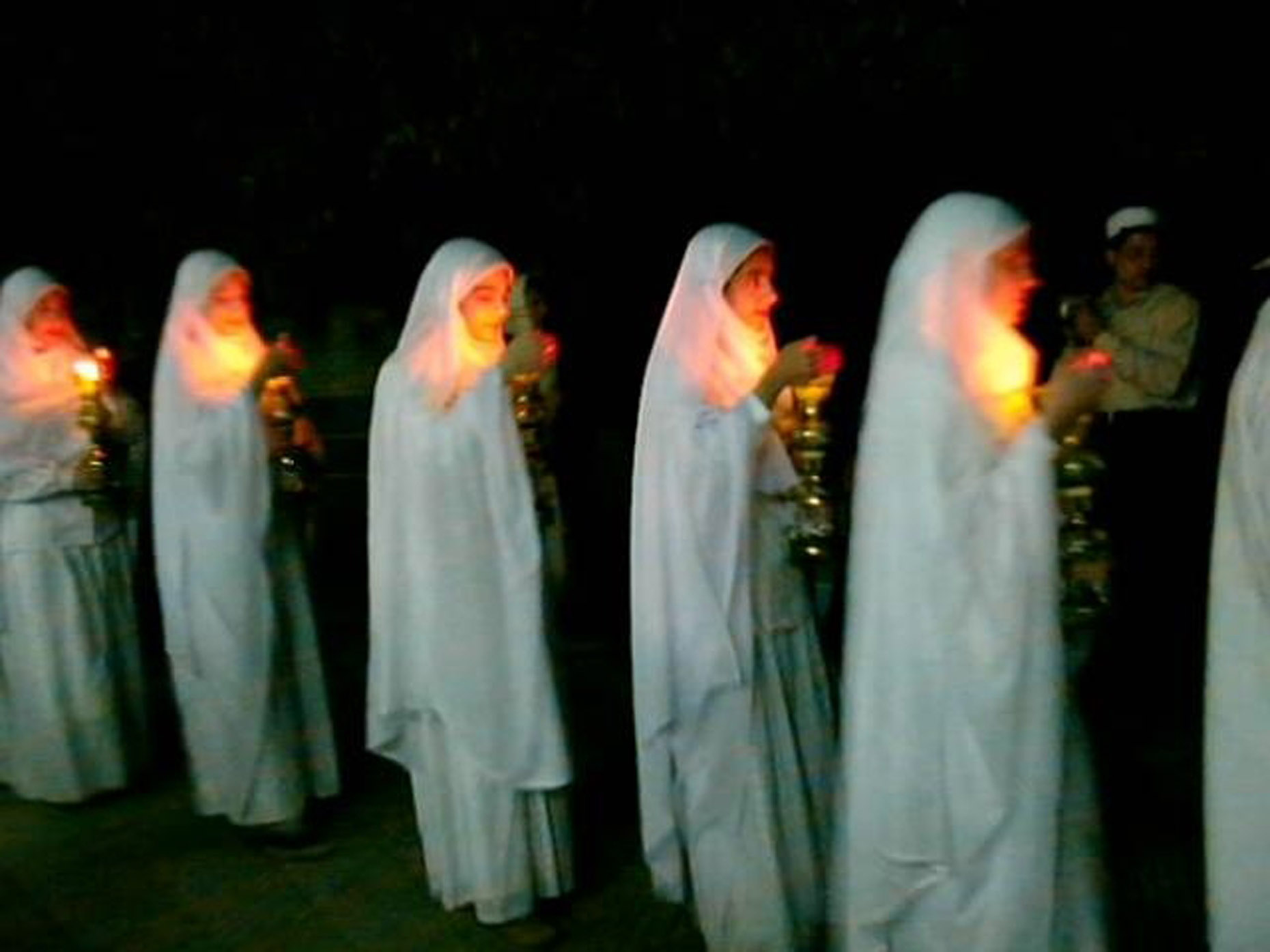
Sadeh/Yalda celebration, Iran. From Iranreview.org

The early Iranian religion Zoroastrianism recognized a holiday they called Sadeh which is now celebrated in Iran as Yalda. Documented as early as 600 BCE, fires were set on December 25 near water and the temples. The fire was originally meant to assist the revival of the sun and bring back the warmth and light of summer. It was also supposed to drive off the demons of frost and cold which turned water to ice and thus could kill the roots of plants.[8]

The Vainakh people of the North Caucasus include the modern Chechens and Ingush who celebrate Malkh on December 25 as the birthday and the festival of the Sun. During the ceremonies suppliants turned to the east.[9] The Hindu Sankranti historically takes place on the Solstice, although the date is January 14, which gives evidence to how much time has elapsed since it started. It is believed that people who die on this day end the reincarnation cycle, for which reason it is very lucky. Gifts are exchanged, sweets and other special food are consumed, and bonfires are lit on Sankranti eve, which is known as Lohari.[10]

More specific to our Western traditions, pagans of Scandinavia and Germanic regions celebrated the season as Yule. People came to the common hall and brought food. It was a three day celebration in memory of ancestors and dates back to the Stone Age in Western Europe. Animals were sacrificed and everyone drank ale. A specially selected Yule log burned through these days as a symbol of the returning sun.[11]

thor
Thor rides in a chariot pulled by two great goats named Tanngnjóstr (Old Norse “teeth-barer, snarler”) and Tanngrisnir (Old Norse “teeth grinder”). From twayneheeter.wordpress.com

Particularly in Scandinavia, the last sheaf of grain from the harvest was preserved for the occasion, believed to hold magical properties and called the ‘Yule goat.’ Another tradition holds that the Yule goat is a spirit that appears during preparations for the Yule to ensure things are done right. A popular theory is that the celebration of the goat is connected to worship of the Norse god Thor, who rode the sky in a chariot drawn by two goats.[12]

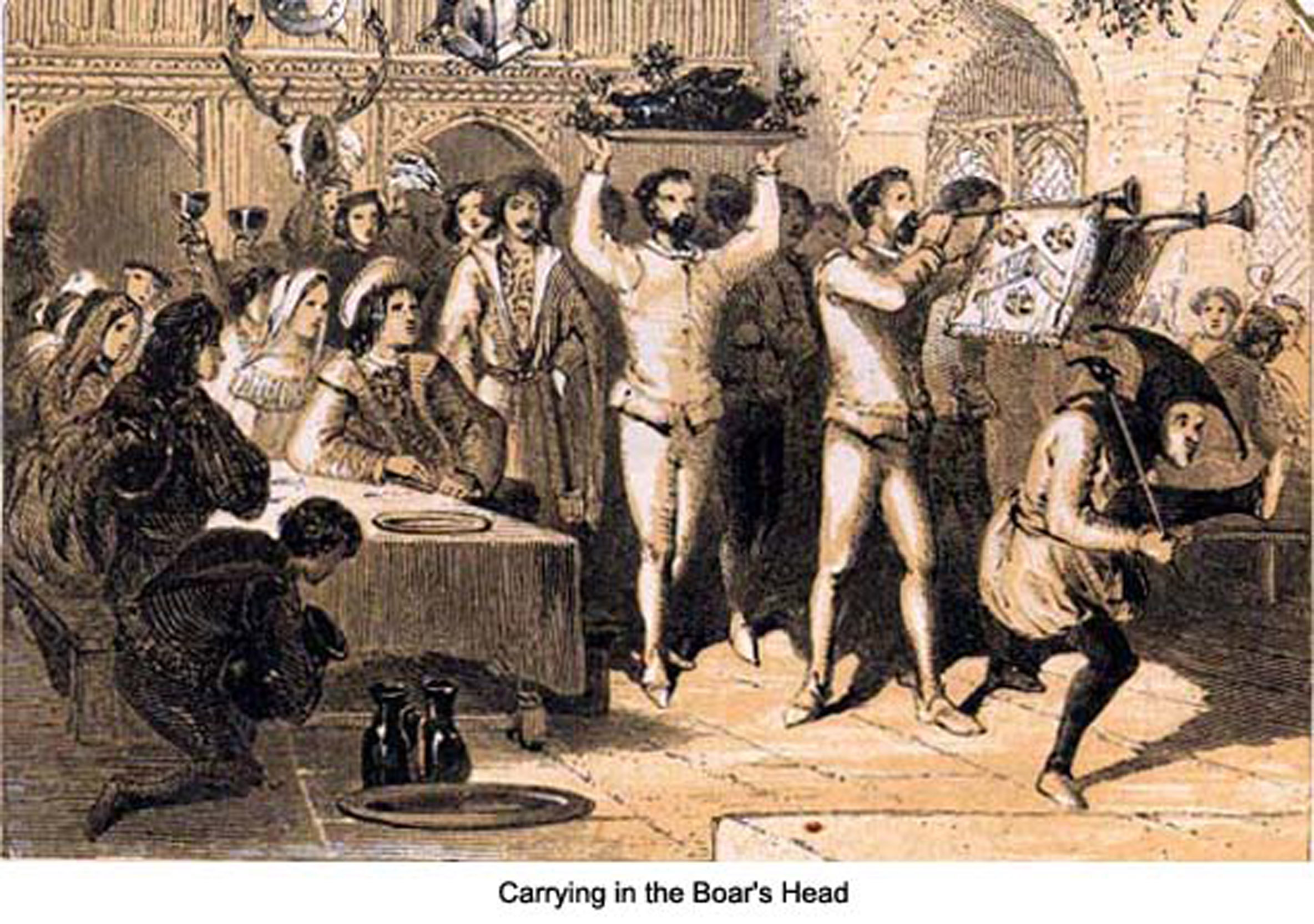
BoarNorthern Europeans also celebrated the Yule boar in a tradition where all men laid hands on the bristles of a sacrificed boar and solemn vows made. There is believed to be a connection between the choice of a boar and the Nordic god Freyr, whose mount is the gold-bristled boar Gullinbursti. The continuing Swedish tradition of eating pig-shaped cakes at Christmas recalls the heathen custom. The serving of a roasted pig’s head at midwinter feasts in England also recreates this ancient tradition as does the serving of a Christmas ham on many American tables. [13]

saturnalia
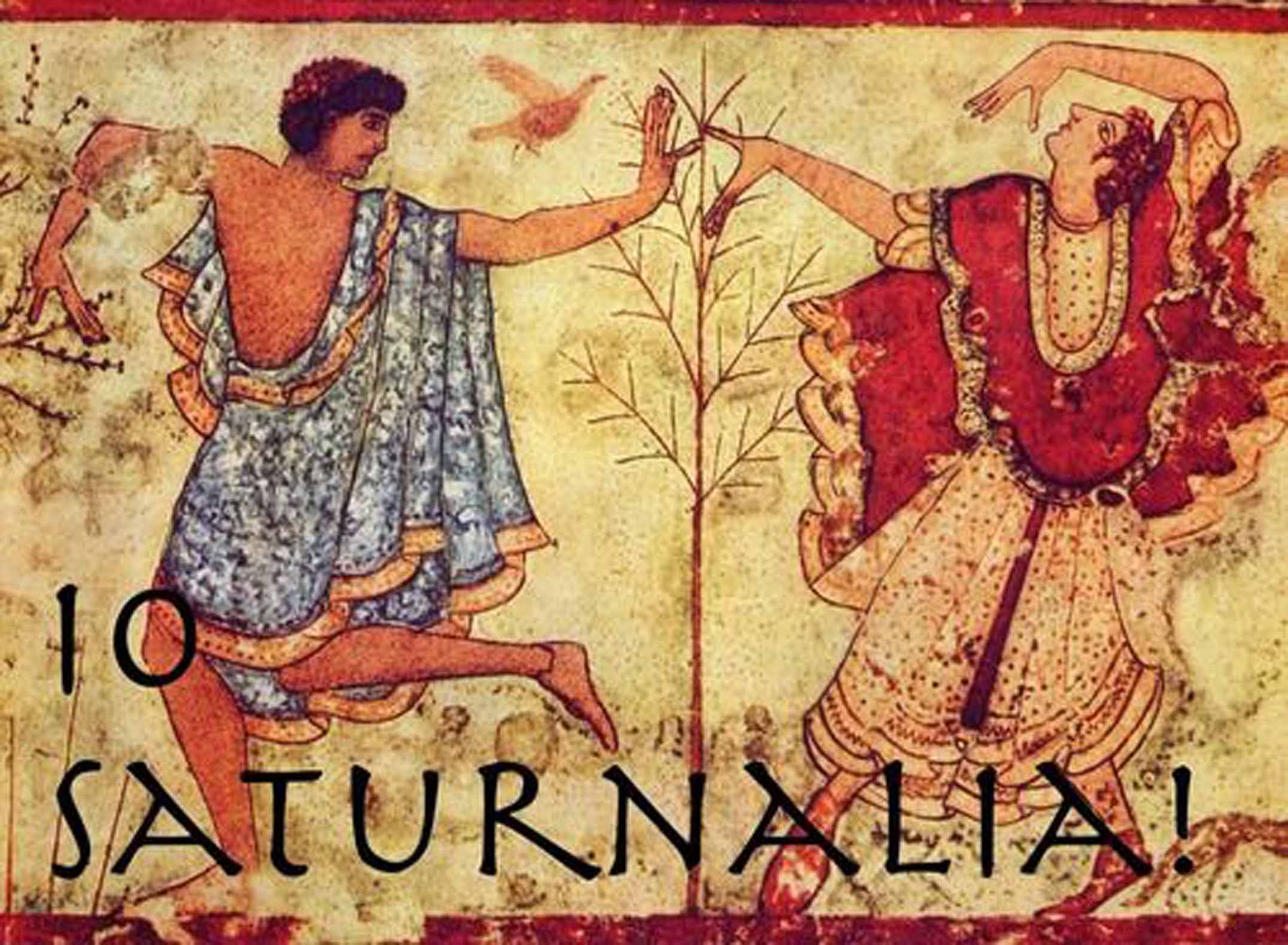
“Io Saturnalia” was shouted as part of the celebration. “Io” translates as “Yo,” an exclamation still in common usage.

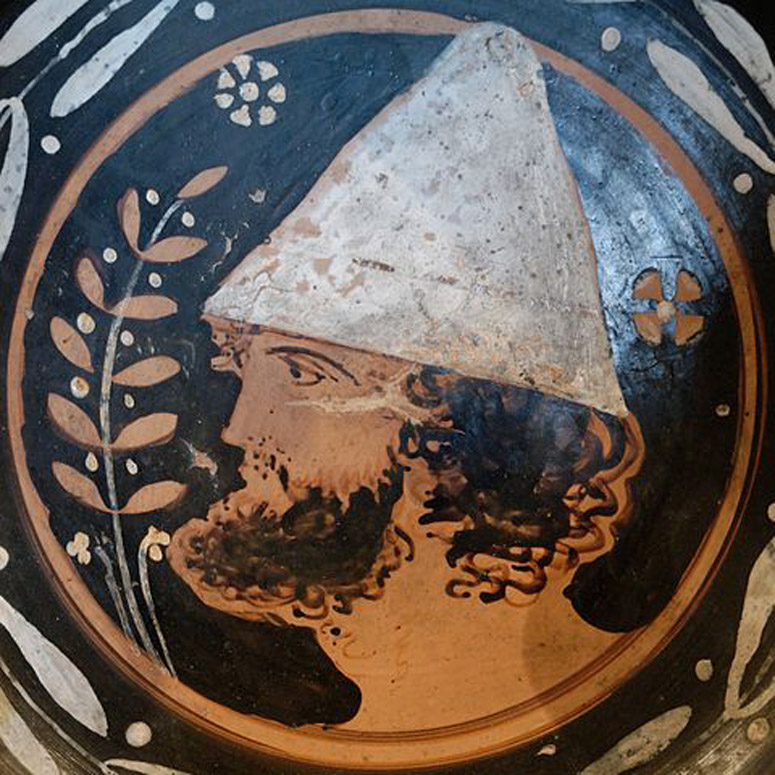
Saturnalia was an ancient Roman midwinter festival in honor of the deity Saturn. It occurred within the broader seasonal celebration known as Brumalia and continued from December 17 through December 23.[14] Sacrifices to the gods, a public banquet, and private gift giving were the primary activities. Candles were given to help drive away evil and encourage the return of the sun. Other gifts included toys for children and gag gifts as well as monetary gifts from employers and ranking members of society to their employees or underlings. On the day of Saturnalia, Roman social norms reversed so that masters served the servants, gambling was allowed, and a carnival atmosphere prevailed. In keeping with the reversal, Roman citizens wore the conical felt hat (pileus) typically worn by freed slaves as a symbol of their freedom, an ancient Greek tradition. The idea of reversal is believed to have symbolized the reversal of the sun’s decline.

Man pilos Louvre MNE1330 by Marie-Lan Nguyen (2009). Licensed under CC BY 2.5 via Commons
The pileus, possibly the inspiration for Santa’s hat? From Louvre MNE1330 by Marie-Lan Nguyen (2009). Licensed under CC BY 2.5 via Commons

In Roman mythology, Saturn was an agricultural deity who was said to have reigned over the world in the Golden Age when humans enjoyed the spontaneous bounty of the earth without labor. The revelries of Saturnalia were supposed to reflect the conditions of the lost mythical age. Following Saturnalia, on December 25 the renewal of light and coming of a new year was celebrated as Dies Natalis of Sol Invictus, the “Birthday of the Unconquerable Sun.”

Similarly, the celebration of Hannukah among Jews tracks the same prehistoric tradition. As noted by one rabbi, “…it is a short leap to surmise that the Maccabees, when they took the anniversary of that day as the day of rededication, were rededicating not only the Temple but the day itself to Jewish holiness; were capturing a pagan solstice festival that had won wide support among partially Hellenized Jews, in order to make it a day of God’s victory over paganism. Even the lighting of candles for Hanukkah fits the context of the surrounding torchlight honors for the sun.”[15]

SantaandgoatThe origins of the Christian gift-bringer figures in European folklore connect specifically with the Yule festivals of Germanic paganism and are often associated with the figure of Odin, the leader of the Wild Hunt at the time of Yule. Santa Claus’ reindeer have been compared to Sleipnir, the eight-legged horse of Odin. After Christianization, the benign mid-winter gift bringer was associated with the 4th century Christian Saint Nicholas of Myra, based on his generous gifts to the poor.[16]

MerryYule
Merry Yule from http://www.kitchenwiccan.com/2013/11/)

The use of mistletoe as a kissing bough evidently derives from a Celtic custom in which Druid priests climbed a sacred oak to cut down mistletoe from which they made an elixir to cure infertility.[17] Holly use during the holiday season also derives from Celtic custom; Druid priests wore wreaths of holly on their heads. Wreaths as household ornaments originated with Greeks and Etruscans (by 600 BCE) as an offering to the gods to prevent crop failure and plagues. Evergreens were sacred because they did not ‘die,’ thereby representing the eternal aspect of the Divine.[18]

yule log
Bringing in the Yule log

Wassailing as a house-to-house caroling tradition follows from the Anglo-Saxon toast Wæs þu hæl, meaning “be thou hale”—i.e., “be in good health.” In medieval Britain, the practice became an exchange between feudal lords and their peasants wherein the lords could practice charitable giving. Songs sung by visiting bands of peasants such as “Here We Come A’Wassailing” and “We Wish You A Merry Christmas” emphasized this dynamic but also hinted at the implied threat that if ‘figgy pudding’ wasn’t given ‘right here,’ vandalism or at least curses might be inflicted upon the manor house.[19]

321px-1870_ChristmasTree_byEhninger_HarpersBazaar
Illustration for Harper’s Bazaar, published January 1, 1870

Christmas trees were relatively unknown in the United States until well into the 19th century and were first considered strictly a German custom. According to the Encyclopedia Britannica, “The use of evergreen trees, wreaths, and garlands to symbolize eternal life was a custom of the ancient Egyptians, Chinese, and Hebrews. Tree worship was common among the pagan Europeans and survived their conversion to Christianity in the Scandinavian customs of decorating the house and barn with evergreens at the New Year to scare away the devil and of setting up a tree for the birds during Christmastime.”[20]

Nativity_tree2011Advent, a period of Christian rituals leading up to Christ’s Mass, began sometime in the late 5th century. The earliest Christmas hymns date to the same period. Modern Christian worship centered on the holiday may involve lighting of candles, prayers, giving to the poor, and other elements of earlier pagan traditions.

The midwinter celebration is the oldest of human traditions. With its darkness and cold, the shortest day gives pause even to the most jaded world citizen. Remembrance of family, feasting, exchange of gifts, and well wishes are no less compelling today than they were in the shadows of our ancient past. Future generations will continue to note this compelling point of the sun-earth cycle, no matter by what name.

May your days be merry and bright!

hd-wallpaper-christmas-gifts-and-globes-wallpaper

Please note I openly confess to shameless usage of cited materials.

[1] https://en.wikipedia.org/wiki/Winter_solstice

[2] BCE refers to “Before Common Era,” sometimes notated as BC, or “Before Christ.”

[3] https://en.wikipedia.org/wiki/Horus

[4] http://isiopolis.com/2011/12/25/isis-osiris-horus-and-the-holy-day-of-december-25th/

[5] http://blog.chron.com/thewiccanway/2011/12/winter-solstice-and-christmas-traditions-and-where-they-came-from/

[6] See also Crump, William D., The Christmas Encyclopedia, 3rd Edition. McFarland. p 369

[7] https://en.wikipedia.org/wiki/Yin_and_yang

[8] https://en.wikipedia.org/wiki/Sadeh

[9] https://en.wikipedia.org/wiki/Malkh-Festival

[10] http://ancienthistory.about.com/od/winterholidays/p/WinterHolidays.htm

[11] https://en.wikipedia.org/wiki/Yule_log

[12] https://en.wikipedia.org/wiki/Yule_Goat

[13] https://en.wikipedia.org/wiki/Sonarg%C3%B6ltr

[14] https://en.wikipedia.org/wiki/Brumalia

[15] http://www.myjewishlearning.com/article/hanukkah-and-the-winter-solstice/

[16] https://en.wikipedia.org/wiki/Christmas_gift-bringer

[17] https://en.wikipedia.org/wiki/Ritual_of_oak_and_mistletoe

[18] https://wicca.com/celtic/akasha/yule.htm

[19] https://en.wikipedia.org/wiki/Wassailing

[20] http://www.britannica.com/plant/Christmas-tree

Creating ISIS

warrior


Some Facebook posts circulating since the Paris tragedy voice outrage that the U.S. and its allies failed to stop ISIS at its inception.

To those I ask what, pray tell, was the beginning?

Was it during the three hundred years of Crusades when Western European Christians invaded the Middle East to drive out Islam?

Was it after WWI when the Western powers reorganized the colonized Middle East, shifting borders to suit the desires of various Western nations regardless of existing ethnic, tribal, or religious boundaries?

Was it after WWII when Western powers again reorganized Arab lands, shoving the Palestinians aside to carve out a homeland for the Jews? Couldn’t we have predicted that Arabs would resist? Perhaps that would have been the best time to nuke the whole region.

Was it when we armed the Afghan Mujaheddin in the 1980s to help them overthrow Soviet occupation? Couldn’t we have predicted that once the Cold War ended, we would abandon Afghanistan and leave tribal leaders like Osama bin Laden to take what he’d been taught to organize his devastated homeland.

Was it when we marched into Iraq, toppling the strong man government of Saddam Hussein and unleashing sectarian violence between Sunnis and Shias?

Was it when the 2011 Arab spring spread from Egypt through other Middle Eastern nations and Syria’s President Assad fought back against his nation’s rebellion? The U.S. and allies hurried into Syria with support and secret ‘advisors’ to assist the rebels, bringing in sophisticated arms and other supplies that are now in the hands of ISIS. Gee, how could we have guessed?

The claim that the U. S. could have inflicted a fatal incisive strike against ISIS at any point along this tortured path shows ignorance and a single-minded obsession to heap criticism on President Obama. ISIS has never existed as a discrete target. Any attack on ISIS would result in massive collateral damage.

The entire mess points to one overarching conclusion: the more we intervene in the Middle East, the worse things get.

We’re good at meddling in other people’s affairs. At what point do we have an honest national dialogue centered on the question: Why are we in the Middle East at all?

I can tell you. It’s because of money, oil and religion. And money. Did I say money?[i]

According to a 2013 report, “over the last six decades, the U.S. has invested $299 billion in military and economic aid for Middle Eastern and Central Asian countries currently in turmoil. Egypt tops a list of ten nations, receiving $114 billion since the end of World War II. Iraq comes in second, getting nearly $60 billion from the U.S. (over and above war costs). Far outpacing those ten countries is Israel, an ally that received another $185 billion in U.S. aid in the same period.”[ii]

Why not just hand all that arms money over to the arms dealers and let them keep the weapons?

Are we getting what we paid for? If the objective is to keep the region destabilized so that we can maintain a level of control over the oil, yes. If the objective is to undermine Arab strength in order to further prop up Israel, yes.

We continue to send billions of dollars of foreign aid to the region, larding the already excessive oil profits lining the pockets of the region’s leaders. With all that money, leaders so inclined can invest in distant terrorists or add to their nation’s arsenal by purchasing arms and equipment manufactured in Western nations.

Supporters of Israel dismiss dollar amounts because their agenda is religious. People concerned about U. S. energy profits dismiss dollar amounts because their agenda is oil. Both groups fail to recognize the larger agenda behind their pet projects: money.

According to a 2013 report, “Each year, around $45-60 billion worth of arms sales are agreed. Most of these sales (something like 75%) are to developing countries. The five permanent members of the UN Security Council (U.S., Russia, France, United Kingdom and China), together with Germany and Italy account for around 85% of the arms sold between 2004 and 2011.[iii]

Nearly twenty years ago, an incisive review of our foreign aid pointed to this folly:

“An examination of $13.6 billion in U.S. foreign aid activity for Fiscal Year 1997 reveals that almost half of the aid is military in nature. This assistance, in conjunction with large-scale arms exports, may actually be working counter to many stated U.S. foreign policy objectives such as promoting sustainable development, protecting human health and fostering economic growth.”[iv]

George Washington famously cautioned against the quagmire in which we’re now floundering:

“The great rule of conduct for us in regard to foreign nations is in extending our commercial relations, to have with them as little political connection as possible.”[v]

Just six days ago, the columnist citing this wisdom called for an end to all but humanitarian aid to foreign nations. He’s not alone.

Opponents of a hands-off approach will cite the potential for increasing interference in the region from nations like Russia and China. In theory, our presence at the arms trade table balances their influence. But we have to ask ourselves, who was there first? I can tell you. It was us.[vi]

If we want the violence to stop, we’ll have to

  • stop giving our tax dollars to nations who spend it on arms,
  • eliminate any and all subsidies to arms dealers and manufacturers,
  • remove our forces entirely from the region and let them sort it out themselves, and
  • rescind and renegotiate any treaties with other nations so that any and all foreign aid is in the form of food, educational materials, medical supplies, and other humanitarian assistance.

Why not? It’s the only thing we haven’t tried.


[i] For an excellent overview of the money problem, see http://www.esquire.com/news-politics/politics/news/a39727/paris-attacks-middle-eastern-oligarchies/

[ii] A graph showing money received by various nations: http://www.huffingtonpost.com/2013/05/06/us-aid-middle-east_n_3223151.html

[iii] http://www.globalissues.org/issue/73/arms-trade-a-major-cause-of-suffering

[iv] http://www.bu.edu/globalbeat/usdefense/whelan0798.html

[v] http://www.washingtontimes.com/news/2015/nov/9/bruce-fein-end-mideast-arms-sales-nonhumanitarian-/?page=all

[vi] https://en.wikipedia.org/wiki/History_of_the_Middle_East

Dazed and Confused

ID-100184515For every new technology, archaeological discovery, or advancement in medical science, there is an equal and opposite reactionary impulse to dive deeper into the ignorance enshrined in fundamentalist religion. Evidence of this mind-jarring disconnect can be found on all fronts.

In March, Florida’s Governor Rick Scott issued a fatwa forbidding state employees from including the terms ‘climate change’ or ‘global warming’ in their studies and reports. He justified his stance by stating that he wasn’t a scientist, which of course is all the more reason he has no business restricting educators, researchers, and scientists on the state’s payroll from using whatever scientific terms they may deem appropriate. Ultimately, this rightwing Republican deferred to his religious beliefs, intimating that God is in control of everything.

Including, evidently, the weather.

A recent proliferation of similar inanities include the appointment of science-denier Sen. Ted Cruz (R-Texas) to the chairmanship of the Senate Subcommittee on Space, Science, and Competitiveness, the placement of rabidly anti-science Sen. James Inhofe (R-Oklahoma) in charge of the committee that oversees the Environmental Protection Agency, and the positioning of Sen. Marco Rubio (R-Florida) to chair the Subcommittee on Oceans, Atmosphere, Fisheries, and Coast Guard, which oversees the NOAA. As noted by one report, “Rubio is a climate change denier…and the NOAA is, after all, the National Oceanic and Atmospheric Administration. Putting him in charge of the NOAA is like installing an atheist as Pope.”[1]

In the same vein of self-righteous stupidity, last fall the House passed a bill that forbids scientific experts from “participating in ‘advisory activities’ that either directly or indirectly involve their own work. In case that wasn’t clear,” says Salon columnist Lindsay Abrams, “experts would be forbidden from sharing their expertise in their own research — the bizarre assumption, apparently, being that having conducted peer-reviewed studies on a topic would constitute a conflict of interest.” Abrams cites Union of Concerned Scientists director Andrew A. Rosenberg in his editorial in RollCall: “…academic scientists who know the most about a subject can’t weigh in, but experts paid by corporations who want to block regulations can.”[2]

The rush to deny science is hardly new. At least since the Middle Ages, persons in the thrall of religion have ignored, repudiated, tortured, and/or burned at the stake anyone who tried to break out of the prevailing mythological bubble. One might have hoped such mindsets were things of the past, but alas, the tendency has picked up steam in recent years. It seems the more we learn about our world, the greater the rush to fundamentalism.

Why and how can this trend occur in the United States of America, where supposedly we enjoy a higher level of literary and education than much of the world?

Would you be surprised if I told you that your tax dollars are part of the reason?

Would you care if substantial portions of state and federal education dollars find their way into funding for religious instruction, much of it extremist?

How can this be? What happened to separation of church and state?

A quick survey finds that through its Child Care Development Fund, the U. S. Department of Education hands out vouchers for low-income working parents to use on childcare anywhere including religious programs. Government similarly looks the other way while handing out tax money to pre-school programs which acknowledge a religious mission, as long as the school claims to isolate the religious instruction to hours before and after the ‘education’ hours, a convenient ruse.

Another effort to spread religion through public education has focused on athletics. Since 1954, the Fellowship of Christian Athletes (FCA) has built a multi-level, global Christian outreach targeting junior high, high school and college campuses. They sponsor team Bible studies, chaplain programs and Bible studies for coaches. One of the requirements for its adult leaders is ‘sexual purity,’ a blanket term covering marital fidelity as well as sexual orientation. So called ‘team-building’ exercises for college athletes include mandatory attendance at church services.

The push for religion in college athletics has resulted in use of tax dollars to pay salaries for chaplains who pray over athletes, counsel coaches, and lead college athletes in religious activities. In some instances, chaplains volunteer for such powerful positions while a few have wages paid by the FCA. Whether on the public dime or not, Christian advocates are given unfettered access to captive audiences in our schools, access provided to no other outside group.

In recent weeks, Freedom From Religion Foundation (FFRF) has singled out the University of Georgia as “one of the major offenders.” The organization noted that Kevin “Chappy” Hynes, UGA’s chaplain, is head coach Mark Richt’s brother-in-law, and cited Hynes as saying, “Our message at Georgia doesn’t change, and that’s to preach Christ and Him crucified, it’s to win championships for the state of Georgia and win souls for the Kingdom of God, so we’re going to continue down that path.”[3] All chaplains investigated by FFRF were promoting Christianity, usually with an evangelical bent.[4]

Aside from the outrage of forced religious activity for non-religious athletes, there’s the mind-boggling absurdity underlying this effort. Does God Almighty care who wins a football game?

All this and still the steady drumbeat of demand for prayer in schools.

The insidious creep of religion into public education and the equally alarming rise in religion-based home schooling steadily increases the number of adults who are functionally illiterate in terms of reasoning capacity. Given the dedicated efforts of fundamentalists to infiltrate all levels of education for our young people, it’s not difficult to understand why an increasing number of legislators don’t understand climate change and refuse to accept any responsibility for the condition of the environment.

The rejection of science and reason in terms of public policy results in steadily increasing collateral damage. The longer we continue to use fossil fuels, the more severe climate change becomes. The more restrictions are placed on sex education, birth control, and abortion services, the more unwanted children are born to desperate lives of deprivation and abuse. The more religion commands top role in policy making, the more likely we will wage war on those of different faiths.

In short, reliance on religion as the most important element in public policy ensures greater human suffering.

It’s not supposed to work that way, as any reasonable person of faith would attest. Religion is supposed to be a path toward love for our fellow man, among other things. The extent to which extremist religion has become an agent of harm is the measure of how its use has been twisted to a less than divine agenda.

Unlike previous times when religion ruled nations, voters still retain the power to rule the United States. Even though approximately 75% of the population claims to embrace some religious belief, only 25% are evangelical Christians. It’s a bigger interest group than any other force in American politics, but they are ultimately less than one out of five of the rest of us.

Reality demands a change in how we regulate tax dollars. Too many inroads have been made in allowing those who cling to outdated beliefs to risk the future of every life form on the planet. It’s time to stand up to the extremist bullies in our midst.

[1] http://www.slate.com/blogs/bad_astronomy/2015/01/13/nasa_trouble_science_denier_ted_cruz_will_oversee_senate_committee_for_oversight.html

[2] http://www.salon.com/2014/11/19/house_republicans_just_passed_a_bill_forbidding_scientists_from_advising_the_epa_on_their_own_research/

[3] https://www.washingtonpost.com/news/early-lead/wp/2015/08/21/why-25-public-universities-have-been-asked-to-drop-their-college-football-chaplains/

[4] http://ffrf.org/news/news-releases/item/23528-state-church-watchdog-issues-report-damning-college-football-chaplains-coaches#sthash.KhWg2v2N.dpuf

Image courtesy of stock images at FreeDigitalPhotos.net

Legal. Immoral.

Artists-impressions-of-Lady-Justice,_(statue_on_the_Old_Bailey,_London)For better or worse, religious affiliation remains an important thread in the social fabric of these United States. ‘Better,’ most would say. Political candidates campaign on their religious credentials. Religious leaders are sought out as advisers in business and community affairs.

A large segment of the population assumes that religion provides important moral guidelines for life. The theory is that without religion, there would be no morality.

But what if the opposite were true? What if religion gets in the way of moral behavior?

The assumption has been that highly religious people such as our locally infamous Justin and Marsha Harris are highly moral. They go to church. They ‘witness’ their faith in public. Mr. Harris has used his Christian standing in his successful campaigns for public office. Their religious mission is to ‘grow God’s kingdom’ at their pre-school by indoctrinating children with religious teachings.

In the last year, events have unfolded that cause many to question the morality of the Harrises. Believing that God guided their steps, about four years ago they adopted two little girls. Within a relatively short time, the girls became such as problem that the Harrises gave them away. The six-year-old was subsequently raped by her new ‘father.’ In March 2015, the story became public.

In addressing that horrible outcome, Justin Harris belatedly stated he felt sorry for the little girls’ experience. Aside from that, he has blamed the state’s social services agency for not helping more. That’s it.

The irony is that the Harrises felt free to dispose of their newly adopted young daughters and then, in the public fallout after their ‘rehoming’ came to light, agreed that such a practice should be defined as a felony.

Is such an act wrong only if it breaks a law? Did the act of rehoming change somehow once the law was passed, so that when Justin and Marsha rehomed these girls, it wasn’t wrong?

The moral reality is that if it’s a felony now, it was a felony when it happened.

Unfortunately, this is often how religion works in people’s minds. An act is immoral, wrong, bad only when someone has already written a rule or law about it. Does the religious person have license to ignore (or never bother to understand) a greater responsibility to adhere to an inner moral code that would say, emphatically, that dumping young children you’ve pledged to make your own is wrong, bad, immoral?

It’s the ultimate mea culpa. Throw up the hands. “Nobody said…”

Justin and Marsha found themselves at a loss about how to handle these two troubled young girls. They pulled out all their parenting skills to punish bad behavior—isolating, taking away privileges, removing toys and entertainment. They prayed out demons and perhaps did not spare the rod. Nothing worked. The behavior became worse.

This would have been a rich opportunity for the Harrises to learn some new parenting skills. Perhaps positive reinforcement, or long sessions of hugging and other positive physical contact, or one-on-one time pursuing new and interesting activities would have been useful in breaking down the wall of mistrust and anger that grew between these adults and their two young daughters.

Sympathetic observers point out that the Harrises had successfully raised three sons, concluding that they must be decent parents. It remains to be seen how well the sons turn out. But it’s also worth questioning whether the Harris’ success in raising their own children wasn’t a result of stellar parenting as much as a result of the boys’ adaptation to repressive, authoritarian parenting from Day One.

We know the girls were capable of appropriate behavior. The foster parents who cared for them before the Harris adoption as well as the family who have subsequently become the girls’ parents have remarked on the girls’ loving nature. Neither families have run shrieking in terror from the girls or found them a threat to the stability of their households. It’s not much of a stretch to conclude, based on this evidence, that the problem between the girls and the Harrises was the Harrises.

The rape has dominated discussion of the Harris’ rehoming decision. But a much bigger issue looms in the background. That is, the immorality of legal behavior.

For example, law enforcement beats up an innocent person because he didn’t instantly abide by police orders. A hunter spends $50,000 to kill a trophy animal. Legal. Immoral. A list of other examples would be long.

As far as I’ve heard, the Harrises have never said they did the wrong thing. Justin never admitted that he may have used his legislative seat (as representative for my home district) to push through an adoption against the expressed advice of caseworkers and the girls’ foster parents.

Yet it was a chain of events propelled by the Harrises which led to their custody of the girls in the first place. Where exactly does the responsibility begin?

Were the Harrises wrong to be so arrogant that they ignored advice from experienced caseworkers? Was it immoral to commit to parenting two very troubled young children and then renege?

Yes.

How is it possible for the Harrises to have engaged in immoral, arrogant behavior and still—after all the exposure and shame—not recognize the depth of their immorality?

I would suggest that their hubris stems directly from pride in their own religiosity.

A recent study found that religious people aren’t more likely to do good than their nonreligious counterparts.[1] This isn’t the first or last evidence that religion does not impart morality. Here’s just one of many comments on this question.

  • These studies begin to provide empirical support for the idea that like other psychological faculties of the mind, including language and mathematics, we are endowed with a moral faculty that guides our intuitive judgments of right and wrong, interacting in interesting ways with the local culture. These intuitions reflect the outcome of millions of years in which our ancestors have lived as social mammals, and are part of our common inheritance as much as our opposable thumbs are.[2]

It makes sense that humans possess innate morality. In the view of those who subscribe to evolution, morality is an evolved necessary component of our continued existence. In the view of those who adhere to beliefs in extraterrestrial interference in human existence, morality would have been a key ingredient in intelligent design. Either way, all investigation points to an innate morality in human consciousness.

Recognition of innate wisdom and individual responsibility should be taught in every pulpit. Instead, especially in fundamentalist religions, individuals are taught to be afraid of their instincts. They’re taught to follow rules laid out in religious texts and nothing else matters.

Inevitably, a person’s avid embrace of institutionalized religion can and does interfere with the application of inborn human morality. The person trusts the religion, not himself. The religion’s rules or lack thereof in any given application supersedes any instinctive understanding of right action.

Assuming that the fundamental element of morality in human nature is not somehow missing in the genetic code of Justin and Marsha Harris, an interested observer would be forced to conclude that it was their religion that got them into this mess. Religion is the reason why, even months after their poor judgment became front page news, they still have not said they made a mistake, have not said they regret what they did. Have not apologized to the state agencies they maligned. Have not asked forgiveness of the public they supposedly served.

They did what they believed their religion and the law allowed. They parented according to a model condoned by the church, perhaps modeled after how they themselves were raised. What they did wasn’t a felony when they did it, therefore they did nothing wrong.

Harris has announced he won’t run for another term in office but stopped short of resigning from a seat he’ll hold another eighteen months. He continues to wield regulatory and fiscal power over the same state agency which he says forced him and Marsha to dump the little girls. He and his wife continue to operate their pre-school where they pass on their questionable religious teachings to innocent children.

As an embarrassed constituent who never voted for this man in the first place, I’ve given up hoping for a Harris epiphany any time soon. Even more regrettably, I doubt we’ll ever hear a word of censure from his equally-religious legislative colleagues and governor.

Perhaps the most we can salvage from this unsavory affair is to recognize the broader lessons. Religion doesn’t confer morality. Worse, an individual’s duty to pursue moral behavior is easily abdicated in favor of going to church.

We need more morality and less religion.

[1] http://www.livescience.com/47799-morality-religion-political-beliefs.html

[2] http://www.qcc.cuny.edu/SocialSciences/ppecorino/INTRO_TEXT/Chapter%208%20Ethics/Reading-Morality-without-Religion.htm