In the late 1990s, I pursued a project that called to me, which was to interview people of the 60s generation who lived in Northwest Arkansas. Many of these were immigrants to the area, the hippies, the drop-outs, the radicals. They came from New York, Detroit, Chicago, Los Angeles, New Orleans, and bought cheap Arkansas land where they could build lives with meaning. Some of the interviewees were locals, also of the Baby Boom generation who saw, rightly, that “the times, they were a changin’.”
What I found in common among those interviewed was a profound understanding that they and the rest of this cohort were responsible for what the future would become. Each acting passionately in his or her own way in arenas of personal interest, these people brought important changes to the region and the world. Whether protecting the environment, furthering the rights of women or racial minorities, or opening their hearts to so many other problems, these were the engines of social changes that are still being fought in our politics.
Often the topic of heated rhetoric and armchair analysis, those who went ‘back to the land’ are rarely heard in their own voice. Now documented in these breathtakingly honest, personal interviews, their stories reveal the guts, glory, and grief of the 1960s social revolution.
The Black Diamond Orchestra first appeared in Fayetteville’s entertainment venues in 1903. They would continue to enjoy bookings in a wide variety of programs for the next thirty years, one of the longest running local talents in the town’s history. Even more remarkable, this entity rose from the depths of the “Holler,” otherwise known as Tin Cup, where the majority of Fayetteville’s Black population lived.
Engagements for the orchestra over the next several years included private parties and receptions as well as bookings by the Shamrock Club, White Chapel Club, and other civic and university entities. By 1911, the group had become a featured event at gatherings such as a Kappa Sigma fraternity dance and a celebration at Fern Dells, “the handsome country home of Mr. and Mrs. W. L. Stuckey on the occasion of the 20th anniversary of their marriage. Over 300 guests were “allowed perfect liberty of choice in the viands [and] left likewise free to choose the place he was to sit and partake of them while listening to the strains of the Black Diamond Orchestra … After the last guests had been served the orchestra was removed from the basement to the stair landing of the big hall where music was furnished throughout the evening and dancing was indulged in by the young and old…”
In September 1924, the University of Arkansas’ new radio station KFMQ featured the Black Diamonds asking listeners to send postcards if they heard the broadcast. “Weeks later, the Fayetteville Democrat reported that the station received postcards from listeners as far away as Canada, New Mexico, and Washington D.C.”
“Colored programs are becoming quite the thing in Fayetteville, with an aroused interest in negro music and African folk-lore. On Friday night a colored troop of entertainers including a local celebrity, E. Young, formerly end–man with Field’s Minstrels when that company had colored end-men, will give an entertainment at Peabody Hall, University of Arkansas, as joint colored church and white school benefit. The Leverett school PTA is sponsoring the event, featuring Black Diamond Orchestra.”
Much more about the celebrated Black Diamond Orchestra and its personnel in The Music Men of Turn-of-the-Century Fayetteville, available in paperback for $19.95.
Mitchell’s jazz band circa 1930, the Arkansas Travelers
Owen Mitchell started teaching music when he was seven years old. A neighborhood boy wanted to learn to play so Owen shared what he knew. That was 1892. He would go on to become the first jazz band leader in Fayetteville. … In increasing demand, the Owen Mitchell Orchestra performed for dances across the region to audiences eager to break out of the war years’ gloom and embrace the new styles of music and dance. The band was among the first to be heard on the new University radio station, KFMQ, in 1924. By January 1925, Mitchell’s radio programming split fifty-fifty between fox trots and waltzes.
… In a lengthy 1949 article in the Northwest Arkansas Times, reporter Doug Jones provided an overview of the local music scene.
“…What I’m talking about are the guys that have and are still living in and around Fayetteville that plenty of local citizens have heard about. All in all, there has been a lot of pretty good music produced in this area, homegrown and home-consumed.
“To those who have followed music, there have been trends in this town reflecting the jazz of the whole country. There might be a few raised eyebrows when I say jazz, but that’s what it was and still is. Jazz music is the basic foundation for all native American popular music. Even more important, to those who haven’t heard, jazz is the only original art form this country has produced. Everything else, Europe or China did first. But jazz is ours, and more and more it is becoming recognized by critics as a true art form.”
From Chapter 3, The Music Men of Turn-of-the-Century Fayetteville, available in paperback at Amazon. $19.95
Henry Doughty Tovey will always be best known as the composer of the music for the University of Arkansas Alma Mater. For everyone who ever attended school there or came to University events like football games, the melodic strains and rich harmonies of that song evoke deeply-felt memories. Without question, Tovey had tremendous musical talent. But that was only a hint at what this man would give to the university, the town of Fayetteville and yes, even the State of Arkansas over the twenty-seven years of his life here.
…Tovey spent the summer of 1909 with friends in Chicago where he discovered the latest version of the Victor gramophone. He immediately purchased one along with a large number of recordings of standard operas including performances by world-famous tenor Enrico Caruso… The gramophone came to serve a key role in Tovey’s grand scheme to offer music education throughout the entire state. Ultimately, his concept caught fire across the nation and even in other places around the world. … Tovey’s growing reputation regarding this teaching method resulted in an article about him published in The Musician, the national journal of music instructors… “The address by Henry Doughty Tovey of the University of Arkansas, which we give in this issue in part, is highly interesting in the demonstration it makes of the wonderful educational power of the talking machine and because it presents such a practical way of working out results. In his plan there is suggestion for every music teacher, for he can use the talking machine in the home and suggest selection of records, and this will have splendid educational results both on the pupil and the entire home.”
…In April 1917, Tovey received notice from Schirmer’s of New York City that their new book, “Energy of American Crowd Music,” would include a chapter about Tovey and his work. No record of this book has been found, but an article thus entitled stated in the preface that “everything we see hear, feel, experience in any way becomes subject matter for music, poetry, painting and sculpture. The things seen and heard in Kentucky or New England or the Ozarks become material for us…”
Much more about this trailblazer in The Music Men of Turn-of-the-Century Fayetteville. Available in paperback, $19.95.
As the 19th century gave way to the 20th, the world of entertainment experienced a massive shift. The invention of electronic media—radio, recordings, movies—brought music to remote homes and new audiences. Sweeping Fayetteville, Arkansas, and its outlying areas before its new wave, the familiar sounds of minstrels and brass bands soon made room for opera, jazz, and the Roaring Twenties.
Key to these transformations were three men and an innovation in the Black community, each taken singly in these chapters. Frank Barr spanned the days of military brass bands to the innovation of his boys’ band that performed soundtracks for silent movies. Henry Tovey, an import from the conservatories of Illinois, took the University of Arkansas fine arts program to unexpected fame. Owen Mitchell, a musician of unusual talent, embraced jazz and led one of the area’s most popular swing bands. Finally, the Black Diamond Orchestra rose from the heart of Fayetteville’s Black community to popular acclaim across the region.
The world of entertainment enjoyed by so many today grew from these roots, from the talented few who generously shared their knowledge and passion and gave music a future of unexpected and thrilling potential.
It should be obvious that everyone in the nation—everyone in the world—benefits when Americans go to college. Americans have earned a reputation for inventiveness and technological advances. Are we ready to give that up?
From James Webb telescope
Back in the day, when the average U.S. worker did just fine with a high school education (or less), the few who went to college were easily subsidized by state taxes up to 80% of the cost. But as the world became increasingly technological, as science became multiple branches of study of everything from our genetic code to the finer points of interstellar rocketry, more and more young people wanted to know more than what high school could teach them.
Few among us want to go back to time when our food supply depended on a plow and a mule and day after day of unrelenting labor, when lights went out with sunset, when one out of every one hundred women died from childbirth. We may feel stressed with the pace of life, but we cannot turn back the tide of progress. The alternative to progress is stagnation, or at worst, destruction.
The United States is slipping behind other nations in the educational achievements of its young people. Rather than analyzing and correcting the reasons behind this decline, our elected leaders succumb to the easy way out which is to facilitate the transfer of tax dollars to private schools and relegate college funding to high-interest loans.
The reluctance, and in many cases the angry protests, of conservatives to support reduction of student loan debt is yet another example of the shortsightedness of this particular slice of our population. These same folks are eager to take advantage of the latest pharmaceuticals, the newest technology in cell phones and digital conveniences/entertainment, as if it all sprang fully formed from the head of Zeus. News flash: These and the many other advancements we enjoy every day are the result of people going to college.
Why would we want to strangle the future our young people can offer?
It could be that there’s a subconscious inclination among conservatives to dig in their heels and not go into that promising future. Maybe the reluctance to facilitate college education is a rejection of modern life and its collection of pros and cons, and instead nostalgia for a long-lost past where completing 8th grade was the biggest accomplishment anyone could expect. That wasn’t so long ago, back when most families lived on a farm and grew most of their own food, when telephones and electricity didn’t exist. But not even the most radical conservative is ready to give up the morning shower, or their cell phone, or the motor vehicle that takes them wherever they want to go.
Progress means finding solutions to problems large and small, problems like Covid 19 (SARS-CoV-2), a virus that so far has left a million Americans dead. In less than a year, our college grads developed a vaccine that provides protection from death and, in most cases, protection from infection, by this virus. Are we ready to give up that kind of science?
The U. S. has to choose whether to continue to lag behind other nations in supporting the education of its young. President Biden and Democrats in general have supported this modest reduction of student loan debt. But over half of student loans will remain to be paid, racking up compound interest that increases the amount owed faster than payments can be made.
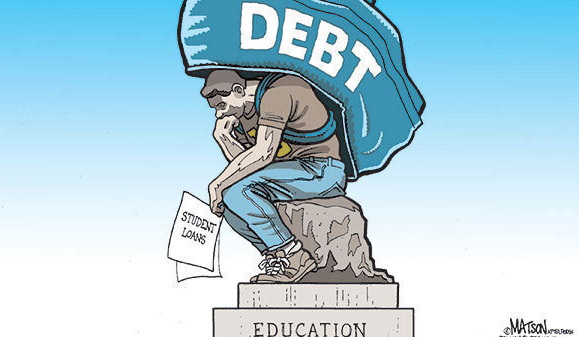
It’s a rigged system. Student loans, unlike any other loan, cannot be written off in a bankruptcy, so even when illness or other tragedies of life crash down on a person’s shoulders, those student loans still must be paid. The cost of higher education continues to increase as colleges try to accommodate the loss of state funding while still providing the advanced education students need.
Higher education is the path to future successes for our nation, not only in medicine but in every other aspect of our civilization. Our supply of food and water will increasingly depend on how well we can mitigate the damage caused by climate change. Our health depends on our ability to stave off more exotic viruses. We need to know more about the causes of diseases like cancer, tuberculosis and Alzheimer’s. When we encourage the pursuit of higher education, we not only address future needs for food and medicine, but also provide for an endless advancement of every aspect of human existence.
We need to move our thinking away from the idea that college is ‘extra.’ While we will always need workers skilled in certain trades that are better taught through vocational schools and apprenticeship, increasingly we need people who can program software, refine microchips, and analyze the human genome. And never forget the thousands of college graduates we rely on every day: doctors and dentists, lawyers and judges, engineers and architects, chemists and researchers, managers and accountants, historians and diplomats, psychologists and psychiatrists, and teachers—to name a few.
It is past time for our educational system to provide affordable college education. One way or the other, a student’s cost for college has to return to a reasonable amount—if not free. States need to shoulder more of the burden, as they did before Reaganomics took effect. Lenders for student loans need to be limited to a one-time charge of interest. Colleges need to find ways to reduce costs.
We face a national emergency in education. Public school teachers need much better pay. Taxpayer funds must never be diverted to private schools which don’t have to accommodate special needs students or which promulgate narrow belief systems. As long as our brightest minds are handicapped by the cost of college education, our nation suffers.
The proud image of our nation, which conservatives love to flag-wave about, is not only about those hardworking linemen, farmers, plumbers and other ‘blue-collar’ jobs, but also about the college grads who figured out how to engineer a tractor that can be operated from an air-conditioned cab while pulling a ten-row cultivator, or who calculated the weight and conductivity of wires to carry our power grid, or who invented flex lines and connector glue to replace labor/cost-intensive copper pipe fittings. It takes all of us.
It’s not a student’s fault that the government shifted student loans over to private lenders who started increasing the interest rates on the loans. It’s also beyond a student’s power to determine what college costs. In 1980, the price to attend a four-year college full-time was $10,231 annually—including tuition, fees, room and board, and adjusted for inflation—according to the National Center for Education Statistics. By 2019-20, the total price increased to $28,775. That’s a 180% increase.
Needless to say, the income to be earned with the degree did not also increase by 180%.
Tuition prices alone increased 36% from 2008 to 2018, while the real median income in the U.S. grew just over 2.1% in the same period, according to data from the Center on Budget and Policy Priorities.
Zane Heflin, policy analyst at The New Center and author of the report titled “The New American Dream: Alleviating the Student Debt Crisis,” says the ramifications of the 2008 Great Recession are still hitting the higher education world, and students are paying the price.
“The two main drivers of the rising cost of tuition are reduced state funding and the incentive for tuition raises as an unrestricted revenue to benefit colleges,” meaning colleges can choose to spend tuition money however they wish, Heflin says. “States and local communities are spending less per student. Someone has to take on that cost, and unfortunately it’s been the student.”[1]
A 2019 report from Center on Budget and Policy Priorities points to cuts in statewide higher education funding for the rapid tuition increase in the last decade.
“Overall state funding for public two- and four-year colleges in the school year ending in 2018 was more than $6.6 billion below what it was in 2008 just before the Great Recession fully took hold, after adjusting for inflation,” the report reads. “In the most difficult years after the recession, colleges responded to significant funding cuts by increasing tuition, reducing faculty, limiting course offerings, and in some cases closing campuses.”[2]
One way or the other, all of us will pay for this outrageous increase in costs for college. One way we’ll pay is to not have access to physicians, dentists, engineers, architects, therapists and counselors, school teachers (happening now), and other professionals who learn what they must know by going to college.
Don’t want to subsidize college education? Schedule an appointment with your friendly plumber for your next dental care.
A second way to address this issue would be for those professionals to charge a lot more when you obtain their services. If you think medical care or attorneys’ fees are high now, just wait until the cost of college means fewer professionals available for your needs AND the higher costs the remaining professionals will charge you.
A third route to address student debt is for policy makers to move past partisan bickering to formulate realistic policy changes regarding higher education. One option would be to remove interest from student loans, or fix it at a very low rate, in order to reduce the cost. It is absurd to allow higher education debt to exist in a marketplace alongside, for example, consumer debt. The need for a new car or a vacation in the Bahamas is far less a priority than the societal need for medical science researchers.
Another option for policymakers would be to reformulate the Pell grant program, expanding the amounts it provides to a more realistic total and allowing the grants to cover graduate school. Perhaps even more critical is the need for government to control the interest rates on student loans. Interest on graduate loans are higher than on undergraduate loans, yet a growing majority of jobs—public school teachers, for example—demand a master’s degree plus regular continuing education credits. Currently, unsubsidized loans for graduate students have a 6.54% interest rate (for the 2022-2023 academic year), while undergraduate students get a 4.99% rate on both unsubsidized and subsidized loans.
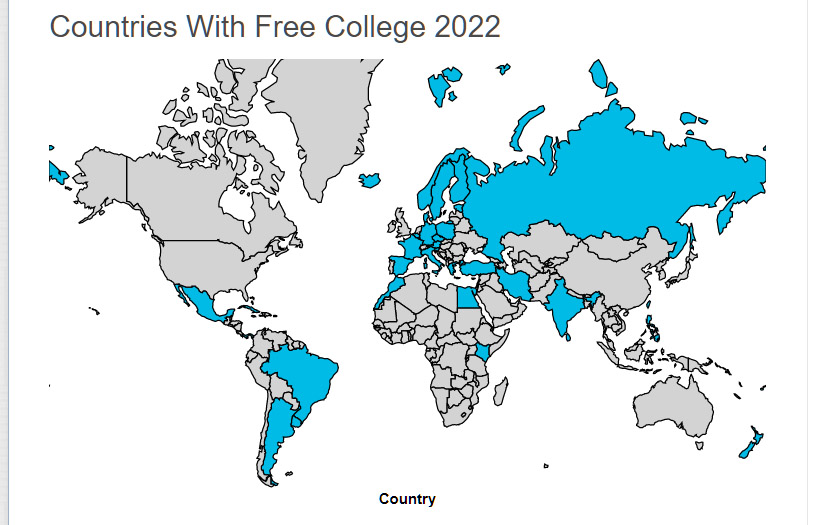
The topic again brings up the comparison between the United States and other nations which provide free college. Even India provides free higher education.
But even if compromise is the only way forward, the U. S. needs to develop a plan that does not bury the poorest students in debt. Sliding scale tuition is one idea. There are already Pell Grants, which provide some money for poor students toward the costs of higher education, and expanding those grants to apply to a broader need is a good point to consider. After decades of providing free college, Britain has taken this approach with policies where “students pick up the bill for, on average, around 65 percent of the cost of the education they receive, with taxpayers plugging the gap. More students are enrolled than ever before and those students benefit from more per student funding than the generations that paid nothing for college.” [3]
According to a recent article at online magazine The Best Schools:
“Why is college so expensive? There are a lot of reasons — growing demand, rising financial aid, lower state funding, the exploding cost of administrators, bloated student amenities packages. The most expensive colleges — Columbia, Vassar, Duke — will run you well over $50K a year just for tuition. That doesn’t even include housing!
“…Administrative costs: These costs account for roughly $23,000 per student every year. This is double the amount that Finland, Sweden or Germany — all boasting top-performing education cultures — spend on the same essentials.
“[Yet] professor salaries have barely budged since 1970. According to the New York Times, “salaries of full-time faculty members are, on average, barely higher than they were in 1970. Moreover, while 45 years ago 78 percent of college and university professors were full time, today half of postsecondary faculty members are lower-paid part-time employees, meaning that the average salaries of the people who do the teaching in American higher education are actually quite a bit lower than they were in 1970.”
“By contrast, ‘According to the Department of Education data, administrative positions at colleges and universities grew by 60 percent between 1993 and 2009, which Bloomberg reported was 10 times the rate of growth of tenured faculty positions.’ The New York Times uses the massive California State University system as a case example, noting that between 1975 and 2008, the number of faculty grew from 11,614 to 12,019. By quite a sharp contrast, the total number of administrators grew from 3,800 to 12,183. That’s a 221% increase.”
These increases are driven by greater demand. As society advances with more technological change, fewer jobs are available to those who do not have a college education. Yes, vocational training and trade schools are important, and those programs should be respected and made available as early as high school. In many states, trades like carpentry and electricians are part of apprenticeship programs subsidized and integrated with unions. Right-to-work states suffer the loss.
Finally, it is incumbent on loan and grant programs as well as colleges and universities to ensure that borrowing students receive clear information about their debt. Many financial aid counselors, especially in public universities, fail miserably in providing necessary information as well as making sure that students have a real-world understanding of the debt they’re incurring.
As summarized in Prudential’s Student Loan Debt: Implications on Financial and Emotional Wellness, there is a wholesale lack of understanding of college loan debt among students and graduates: Many student borrowers—53 percent—didn’t know their future monthly repayment amounts. Most—74 percent—were unsure of how long they would be making payments, and 25 percent had no idea whether they had private or government loans.
Those who are outraged by the idea of student debt forgiveness might take some initiative here to help solve the problem. It will take all of us thinking and contributing to the dialogue in order to best serve the future needs of our nation.
In the late 1960s and early 1970s, an exodus from the cities brought hundreds of new settlers to the Arkansas Ozarks. Their personal stories are testaments to an awakening shared by many of the Baby Boom generation, personal and communal. This interview is one of 32 personal stories gathered in 1999-2000, and published in Aquarian Revolution: Back to the Land.
I didn’t like the way I was treated as a kid. I was beaten regularly. I don’t think I’ve cried since I was seven years old, because if I cried, they would beat me with a leather strap until I stopped crying. I had a bleeding ulcer from age twelve until it healed up after I left home right before my eighteenth birthday. I had a shrink and a probation officer trying to get me out of my house legally.
I ran away at thirteen and was involved with a stolen car. I remember when we ditched the car, this other kid I was with, he was fifteen, big kid. We were on our way to pick up some fake plates and police chased us because they recognized him so we dumped the car. We jumped out of the car doing about 45 mph, leaving my guitar case and suitcase with birth certificate, everything telling them who I was, and we ran, picked up a third guy, jumped on a bus to Baltimore, blew all the money we had, started hitchhiking. We were on our way to California. The police picked us up at two a.m. on the highway. I never gave them my name. I was planning on breaking out of jail. I can remember when I was riding that bus, I was thinking about my parents and how much I loved them, but I just couldn’t stand to live with them.
That was about the time I started getting high. A lot of things were about to break then, one way or another. It was either going to come out of me in violence, or… I think I found a channel to do it naturally and just chill out. Just reach in.
They made me see a shrink when I was thirteen because of the stolen car. He said I was afraid to express myself with my dad and that’s why, if anybody crossed me, I’d be right on them. After thirteen, I was getting into a lot of trouble. I was a practical joker who did things I probably shouldn’t have been doing, but I did it with a smile. I had my destructive period. One night three of us smashed a car that was parked alongside the road. We used sticks and rocks and beat it in. Totaled it. Those were heavy years.
I think it was being able to smoke that pulled me out of it. My friends were mostly tough guys, had attitudes. By the time I was seventeen, I had started to drift off with the ones who didn’t. I remember violence on TV, violence was everywhere. It was either protests or Vietnam. At sixteen, if anyone defied me, I would be down their throat in a second. One time a teacher put me in the front seat of the class, wouldn’t let me sleep. I was, man, you won’t let me sleep, what kind of a deal is this? I might have been getting a D at that point, but I didn’t care about that class. He put me in the front seat, banged my shoulder or something, made me wake up and started talking to me, I told him to leave me alone and he did something else to irritate me, and I jumped out of my seat, grabbed him by the lapels, dragged him across his desk, and smashed him into the blackboard in front of the whole class, and said “Leave me the fuck alone.” So of course they threw me out of school instantly.
That was my attitude with anybody. People would come to me from the grade ahead, bigger kids than me, and say hey, this guy’s doing this and that, and I’d go confront him. And I wouldn’t just confront him and intimidate him with anger, I’d put it into words. I’d say something to them that they couldn’t argue with. I didn’t want to argue with anybody, but if you’re going to argue with me, stand back or get out of the way, save yourself. My dad didn’t think I was a man because I wouldn’t be angry with him and fight back. Yet I’d go out and fight and do all this.
Coming out of that, I started being friends with all the teachers I had given trouble. My shrink might have been talking with my parents then. I had two shrinks, one my mother took me to and one that came to my school once a month. I had a probation officer, too. First time I went to the shrink, I sat to talk to him, and he said, ok. Then I went out and he talked to my mom. I come back in and sit down and he looked at me and said, K–, I cannot talk to your mom.
She was so headstrong. You did as she said or whack, or twist your ear. Most of my physical abuse was from my mom. It reached a point with my mom that I was more verbal. By the time I was ten or so, my mom didn’t scare me.
I ended up getting married my senior year. I was moving out. I’d run away another time, it was the third time. It wasn’t like running away. I was walking back and forth with my clothes, patting my mom on the back, saying it’s ok Mrs. C–, it’s ok. I was outta there. My wife’s parents took me in. The probation people were trying to get me out of my house before I was eighteen, if I could find somebody. They knew that anything was better than where I was. As hard as I might have been trying, chilling out, it was hard pretty much to the end.
Finally, I argued back with my dad and that was it. I made a quick exit because he just wanted to knock my block off. I think that changed him. He kind of stopped by the time I was seventeen, eighteen, when I was working for his business doing electrical. …
~~~
Now retired from a successful self-employed career, the subject of this interview moved to Hawaii where he has opened a meditation retreat. Read the rest of his compelling story, available for only $4.99 (ebook) or $11.32 (paperback), at Amazon
Abortion has been, and continues to be, a vital weapon in the Republican toolbox, a means to gain control over a multitude of less savory objectives. With this hot button, they have been able to whip up energy within their ranks. Over the last fifty years, a growing mob of zealots have taken to the streets and the halls of government with placards showing the pitiful fetus so wronged by evil women and their fiendish abortion doctors.
The truth is that the flap over abortion was never as much about the ‘unborn baby’ as it was about political capital. Powerbrokers saw right away that this issue aroused emotion like nothing else. Yet what the Republican Party stood for, then as now, also enshrined racial prejudice, but it had become impossible to openly advocate for white supremacy.
The mass migration of voters from Democratic ranks to the shelter of the Republican Party began not with Roe v Wade, but with the 1952 Brown vs Board of Education decision and followed more decisively with the Kennedy-Johnson push for civil rights. The Civil Rights Act of 1964 forbade discrimination on the basis of sex as well as race in hiring, promoting, and firing. The Act prohibited discrimination in public accommodations and federally funded programs. It also strengthened the enforcement of voting rights and the desegregation of schools.
Police dogs, held by officers, jump at a man with torn trousers during a non-violent demonstration, Birmingham, Alabama, May 3, 1963. Police officers used both dogs and firehoses to break up the rally.
After the 1964 Civil Rights Act, many white, conservative Southern Democrats became Republicans. The South had been mostly Democratic before 1964; it was mostly Republican after (although on the local level continued to be heavily Democratic for decades). Many “values voters” became Republicans.[1]
The 1973 Roe v Wade decision legalizing abortion did not have nearly the same impact as the Civil Rights Act as far as political response. For a time, other issues sidetracked voter attention, such as the winding down of the Vietnam War and the Watergate scandal that shoved Nixon out of office. The Arab oil embargo also diverted public interest with skyrocketing gasoline prices. In reality, the behind-the-scene Republican strategists were slow in coming around to a full understanding of how to use the abortion issue to represent the real interests of conservatives.
Early in Reagan’s presidency, developing tactics on the abortion issue spread through the nation in the hands of then-fledgling evangelical groups wielding signage of dismembered fetuses (remarkably mature for the gestation dates named) and demonstrations by women crying for the lost babies or, more heart-rendering, testimonials by women who had obtained abortions and later regretted it. (This vanishingly small group remains an active feature of anti-choice campaigns. One could sum up their position as yet another demonstration of ignorance.)
At first, Democrats yielded ground on the matter, not firmly convinced enough about women’s right to bodily autonomy to take a firm stand. Lamentably lacking in early opposition to the anti-abortion crowd were strategies to fight back with their own weaponry, for example, citing Biblical scriptures showing that personhood began at birth.
After God formed man in Genesis 2:7, He “breathed into his nostrils the breath of life and it was then that the man became a living being”. Although the man was fully formed by God in all respects, he was not a living being until after taking his first breath.[2]
Democrats have finally taken a stronger stance on the topic, linking the party to “their support of ‘human rights’ and of groups whose rights have been long suppressed – African Americans and other minority groups, women seeking to vote and enjoy full property rights, LGBTQ people and immigrants.”[3]
To Republicans, the abortion issue is a coded message about the party’s stance on longstanding prejudices, not only uppity women but also African Americans and other minorities, LBGTQ people, and non-white immigrants. Without having to advertise racism or other prejudices, Republican strategists can push voters to champion the rights of the fetus while avoiding the party’s full agenda.
It is not the facts of an issue which drive evangelical voters. As a general rule, evangelicals don’t embrace facts. Their hands are full of Bibles, which they don’t precisely understand, but they do hear what preachers tell them. What the preachers tell them is intended not to elucidate the facts but rather to stoke FEAR of God’s wrath. And, in these narrow hallways of evangelical mentality, God will punish them if they don’t stop women from killing fetuses.
It’s not that evangelist preachers are pursuing a goal they understand in terms of social policy. Their vehement sermons about abortion and their endorsement of specific political candidates derive from their urgent personal desire to make money off of Jesus. Evangelicals are an easy mark. See, for example, the fundraising headline at Focus on the Family’s website: “SAVE 2X THE BABIES FROM ABORTION! Double Your Gift to Save Lives!”
The more insidious objective of the Republican agenda is to continue shifting power to corporations and the super wealthy while the frontmen lure evangelical voters with the promise of a Christian nation. Sadly, evangelicals lack any understanding of the threat posed in religion as government, a condition that increases exponentially as more private religious schools and homeschooling take the place of public education.
Remedies for the current crisis would include regulations that deny diplomas to any student, homeschooled or otherwise, who cannot pass examinations proving understanding of American history and government, among other subjects required of public school students. If U. S. citizens cannot begin adulthood on the same page, we have no hope of continuing as a nation.
One thing such an education would ensure is the awareness that the Republican/evangelical drive toward a Christian nation is a form of sedition, “an overt conduct, such as speech and organization, that tends toward rebellion against the established order. Sedition often includes subversion of a constitution and incitement of discontent toward, or insurrection against, established authority.”
Equally tragic is while Republican power brokers chortle over wins for the One Percent, they have failed to recognize the puppet master profiting from their maneuvers: Putin.
Trump’s victory lap over the demise of Roe v Wade unveils one of the subtle purposes of Vladimir Putin’s support. The Russian ploy to undermine U.S. society gained a witless ally in Trump, who pulled his best con job in his election to the presidency, aided and abetted by the machinations of Russian interference.
What has now been made clear is that Russian trolls and automated bots not only promoted explicitly pro-Donald Trump messaging, but also used social media to sow social divisions in America by stoking disagreement and division around a plethora of controversial topics such as immigration and Islamophobia.
The overarching goal for Russia, during the election and now, analysts say, is to expand and exploit divisions, attacking the American social fabric where it is most vulnerable, along lines of race, gender, class and creed.
“The broader Russian strategy is pretty clearly about destabilizing the country by focusing on and amplifying existing divisions, rather than supporting any one political party,” said Jonathon Morgan, a former state department adviser on digital responses to terrorism whose company, New Knowledge, analyzes the manipulation of public discourse.[4]
Russia’s desired outcome in the months before Donald Trump’s election in 2016 was not simply to see him elected. It aimed, instead, to more broadly “undermine the US-led liberal democratic order” (in the words of a January 2017 intelligence assessment), an effort that Russia believed would be aided far more by Trump’s election than Hillary Clinton’s. This overlapped with its desire to “provoke and amplify political and social discord in the United States” (in the words of special counsel Robert S. Mueller III), leading it to weigh in not only on electoral politics but cultural fights — investing in amplifying and exacerbating contentious social debates.[5]
[2] Also Job 33:4: “The spirit of God has made me, and the breath of the Almighty gives me life.”
Ezekiel 37:5, 6: “Thus says the Lord God to these bones: Behold, I will cause breath to enter you, and you shall live. And I will lay sinews upon you, and will cause flesh to come upon you, and cover you with skin, and put breath in you, and you shall live; and you shall know that I am the Lord.”
Exodus 21:22: If a man causes a woman to have a miscarriage, he shall be fined; however, if the woman dies then he will be put to death. It should be apparent from this that the aborted fetus is not considered a living human being since the resulting punishment for the abortion is nothing more than a fine; it is not classified by the bible as a capital offense.
John Randolph Campbell, holding a Bible, believed in his late 20s circa 1875-1880
Records of John Randolph’s birth name a birth year of 1853, although various other records show conflicting dates. A church record states that he was born December 24, 1853, in Independence County, Arkansas. In 1873 at age 19, he married Sarah “Sally” Elizabeth Prince at Sulphur Rock, Independence County, Arkansas. She was his second cousin once removed.
Miss Prince was born September 1849 in Tennessee, daughter of William Prince and Martha Lamberson. This Lamberson is related to John’s mother’s family: Melinda was her first cousin once removed. William J. Prince was born 1813 in Georgia, and died during the Civil War in Independence County, Arkansas, as did his wife Martha Lamberson Prince, born 1825 in North Carolina. Sarah Sally’s siblings were William H., b 1842 TN (CSA AR 8th Inf. Co. E, enrolled August 6, 1862 at Sulphur Rock, AR, between Newark and Batesville); Mary A., born 1847 TN (married James Scott); Virginia b 1850 MS; James Ferdinand b 1852 AR; Martha Jane b 1857 AR (married George Hill 1872; David Bruton 1879); John T. b 1858 AR; Tennessee “Babe” b 1860 (raised by Mary, married Riley Whaley).
Birth records for the couple’s sixth child, Benjamin, dated 1888, states that John age 38 was a farmer and preacher, born at Newark Arkansas, and that Sarah age 40 was born in Mississippi.
John Randolph Campbell and his new wife Sally produced the following children:
i. Emma Campbell b. 1874, Newton Co., AR, d. 1888 of rheumatic fever at age fourteen
ii. Mary Molly Campbell b 1876, m. Frank Pratt(s). Children were Mabel m. Fred Albert; Lizzie m. John Hilburn; Beulah; Pierce; Lennox; Urcil “Huck”; Margie; Nettie (died).
iii. John William Campbell, b 1878, m. Mary Jane Ellis. John William is the great-great grandfather of my three Campbell children.
iv. Jack O’Neil, b. Dec 25, 1882 at Newark, Indep. Co, AR, d. Apr 14, 1960, Newport, married July 19, 1903 to Emma Bell Hicks and produced Lennie Mae, Bertha, Commie O’Neal, Rutha Lee, and Opal Christine. Jack then married Donnie Inness and produced another eight children: Edna Irene, Burl Nathaniel, Aubrey Evereett, Almeta Beatrice, Leeaun Utah, J. C., Alvin Newton, and Thelma Joyce.
v. James Campbell b 1880, m. Mary Willis. Children were Dallas, Nanny, and another daughter.
vi. Clu Campbell, died at age 9 – not found in family birth records
vii. Benjamin Harvey Campbell, b June 14, 1888, Pleasant Plains, Indep. Co AR, d. Nov 19, 1966, Newport, Jackson Co, AR. married Willie Hicks, married Ocra Ellen Tibbs, and their children were Eva Jewell and Clemins Alvin. He then married Helen Carmen “Nell” Yancy, and produced Vesta Lola, Virginia Vivian, Mather Carnell, Veda Lee, Milous Harvey, and Benjamin Morris.
The 1880 Newton County Arkansas census for Jackson Township lists John Campbell age 26 with wife Sarah age 25, with children Emma age 6, Mary age 4, John age 2, and James six months. John’s occupation was farming.
John Randolph and Sarah Prince Campbell, circa 1900
The 1900 census for Fairview Township, Newton County (?) lists John R. Campbell age 46 as a mail carrier, land owner with a mortgage, married 27 years to Sarah, age 50, with seven children of which five were living. Jackson, age 17, was a hack driver, and Harvey age 13 was a farm laborer. They housed a lodger named William Hicks. The 1920 census for Jackson County Arkansas, Richwoods Township, finds John R. Campbell age 67 and Sarah A. age 72 living in a rented home, with his occupation described as clergyman and evangelist. The 1930 census for Amagon (Richwoods Twp) lists John R. age 80 and Sarah age 84 living in a rented home without occupation.
John Randolph was about five-nine at 185 pounds, although in older age he became “heavy set.” He worked as an itinerant preacher, following the Church of Christ denomination. “On September 29, 1895, John R. Campbell was authorized to work as an evangelist by the “Disciples of Christ, worshiping at Surrounded Hill Arkansas.” In 1889, he was ordained as a preacher by E. M Kilpatrick, and J. L. Kitridge, Clerk for Tex-Ark & Indian Territory: Credentials, page 32.
This poor quality image shows John Randolph in the process of baptizing a convert, date unknown.
According to one descendant, “John Randolph used to preach near Bradford [Arkansas] at least once a month; Aunt Nell [wife of Benjamin Harvey] remembers hearing him preach in 1914 near Swifton … said his name was Campbell and he was a Campbellite preacher. In 1917 he lived in the Pennington community and preached at different places. He received very little money as payment, mostly fresh vegetables, canned food, and some meats. Aunt Nell said she overheard some older women talking about the time he received a large handkerchief and two week’s board for holding a meeting. He preached some at Amagon and went to church barefoot … services were held in the schoolhouse.”
John Randolph and Sally, date and location unknown
He also rented farms to grow cotton and he traded horses and any other item of value. When his third child John William and family settled in Fayetteville after 1918, John Randolph and Sarah joined them, living first at John William’s store at the corner of Rock and Mill, then on Frisco Street and finally on the south side of Spring Street in the four hundred block before moving back to east Arkansas. His grandson John Carl later recollected that he drove an old Overland Blue Bird.
Overland Blue Bird
One descendant stated that “John R. Campbell was a preacher. He was really a corker. Pulled some pretty good stunts. Think he drank a lot.” It was said by his grandson Zack that there were only two places that John Randolph would drink home brew, and that was “on this side of the Bible and on the other side.” His wife Sally dipped snuff, and sometimes smoked a cob pipe. Sally’s daughter-in-law (Mary Jane Ellis) stated that the Prince women were known to have “woods colts,” a euphemism for illegitimate children. In old age, Sally suffered a “dowager’s hump,” now known as osteoporosis. Sally and John Randolph both died in the Newport Arkansas area.
Mary Molly Campbell
Little is known about William and Melinda Campbell’s second child, Mary Molly. She is not listed in the 1860 census of Howell County Missouri. Later records show her spouse as John Willis Payne. Willis was born in 1854 in Kentucky, with both parents also born in Kentucky.
Willis and Mary Payne are found in the 1880 Newton County, Arkansas census, Jackson Township, at ages 25 and 26, respectively, evidence she was born in 1855 two years after John Randolph. Also in the household is her younger brother James, listed a ‘boarder.’
In a letter dated 1971 from Elizabeth Campbell Farmer, daughter of James “Jim” William Campbell, Elizabeth states: “Mary Payne is my papa’s (Jim Campbell) only sister. We called her Aunt Molly and she was married to Willis Payne.”
After 1880, Willis and Mary vanish from public records.
James William Campbell
James William Campbell with his first wife Nancy Jane Bell on his right and her half-sister and his second wife Eliza Lawson on his left, circa 1888. James holds a pistol in his hand.
At age 24, James married Nancy Jane Bell (age 19), daughter of William Levi and Nancy Busby Bell, September 18, 1882, in Newton County, Arkansas. This was two years after he was named as ‘boarder’ in the household of his sister Mary and brother-in-law Willis Payne. James and Nancy moved to Harrison (Boone County) Arkansas but in 1886 they moved back to Newton County where they settled in the Mt. Judea area (pronounced “Judy” by locals). There James dug wells and cisterns and built chimneys, as well as farming his land with cotton, corn, and small grains. He was a “great hand with a scythe and cradle and would get $1.00 per day for cutting wheat, a good wage for that time and more than most men were paid.” His son, Wesley A. Monroe, said they had “biscuits one to three times each day during the wheat harvest then cornbread three times a day for the rest of the year.”
He was elected Justice of the Peace in 1892 and remained in office for years. About the same time the family moved into a “box” house on land they homesteaded, a cause for celebration since most families lived in rough log cabins. In his capacity as JP, he married many couples and was said to shed tears during the ceremonies. He only went to school two days in his life, according to his descendants, but was a self-educated man. He taught school two summers – “Script” or conscript school. Each family paid one dollar for each child attending.
James and Nancy Jane Bell Campbell 1905, with children Dewey Floyd (between them) and Rosa on right
In the fall of the year, James would go away to pick cotton (probably in the river bottoms) and would take his wife’s handicapped half-sister Eliza Lawson as well as his older children. His wife Nancy Jane stayed home to care for the younger children and the homestead. It is said that James and Eliza lived as husband and wife during the cotton-picking trips. Nancy spun thread and wove most the cloth used for their clothes, including coats. The pants and coats were made of half wool and half cotton, called “linsey-woolsey.”
James also served in some capacity with the Spear Mining Company for their lead and zinc mine near Pendle. He was a school trustee for the board of education and helped to hire teachers. He was a “jack of all trades,” doctoring animals and people by setting broken limbs on splits that he whittled. He farmed and grew everything his family ate, including the livestock.
The eleven children of James and Nancy, as well as his child by Eliza Lawson and children by Nancy Walls, his third wife, are not listed for sake of privacy.
Sarah E. Campbell
The 1860 census, taken July 19, gives Sarah’s age as one month. Thereafter, no record of her is found. Assumed she died in infancy.